He left Kolkata for Paris in 1956 and never fully came back. Seven decades later, the Indian market finally caught up: some of his large Durga canvases now sell for several crores.
Why Burman, why now
Sakti Burman is one of India’s most important living modern painters, and one of the last links to the generation that took Indian art to Paris. Now in his nineties, he still works between Paris and New Delhi.
Four recent sales show how strongly bidders have responded to his Durga paintings:
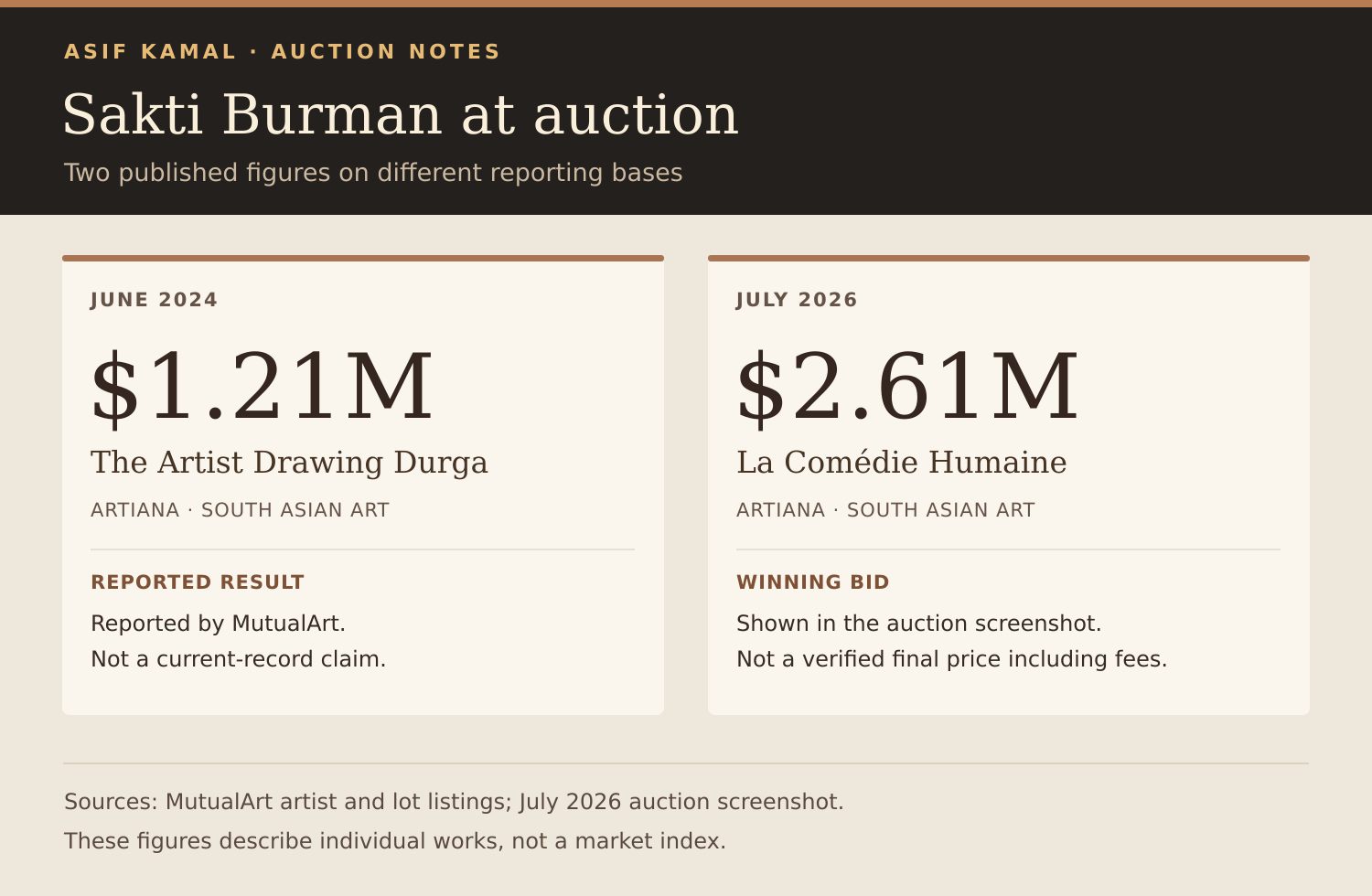
- 2024: The Artist Drawing Durga sold for about $1.21 million at Artiana, according to MutualArt.
- April 2025: a circa-1995 Durga made ₹7.20 crore ($847,059) at Saffronart’s 25th anniversary sale, against an estimate of ₹4.5–5.5 crore.
- August 2025: another Durga (c. 2004) sold for about ₹4.15 crore at AstaGuru, according to Masterworks Academy, against a ₹1.5–2.5 crore estimate.
- December 2025: Mother Durga sold for ₹6.90 crore ($775,281), including buyer’s premium, at Saffronart’s Winter Live Auction.
July 2026 brought a separate high-end example beyond the Durga paintings. La Comédie Humaine (2008), an oil on canvas measuring 162 × 130 cm, was offered at ARTIANA’s South Asian Art auction, July 9–13, 2026. The auction screenshot shows an estimate of $1–1.5 million and a winning bid of $2.61 million. ArtInScapes reported approximately ₹25.19 crore. MutualArt confirms the lot and sale dates but does not display a public result. The screenshot’s winning bid is not presented here as an independently verified final price including fees.
In the same Saffronart auction in May 2005, Conversation sold for $33,550 and Intimacy for $72,050 against an estimate of $35,000–$40,000. Two sales from the same auction show why a single result is a poor baseline for an artist’s whole market.
Bengal, 1935–1956: a village childhood
Burman was born in Calcutta in 1935 to Umatara and Adinath Burman. His mother died when he was a few years old. He grew up at his grandparents’ farmhouse in Bidyakut, a village now in Bangladesh, and later in Dibrugarh, Assam.
That village supplies most of his images. The household celebrated every puja and festival: walls freshly painted, women drawing alpanas on the floor, village musicians playing. Durga, Ganesha, Shiva on Nandi, owls and peacocks all came from there.
His father, a patron of culture, still opposed art as a career, fearing his son would not earn a living. Burman went anyway:
- 1951: begins a five-year fine-arts course at the Government College of Art and Craft, Calcutta.
- 1954: first solo exhibition, in Calcutta, aged 19.
- 1956: graduates, and wins a French government scholarship to Paris.
Paris, 1956–1980s: finding the marbled surface
In Paris, Burman entered the École Nationale Supérieure des Beaux-Arts and won its Prix des Étrangers, the foreign artists’ prize, in his first year. He also took a silver medal at the Salon de Montmorency.
- 1958, Italy: the frescoes of Giotto and Piero della Francesca showed him the chalky, aged surface he would chase for years.
- Early 1960s: he travelled between Paris and India but found few Indian buyers. At the Beaux-Arts he met the French painter Maïté Delteil; they married in 1963.
- The Indian sites: before their daughter Maya was born, the couple toured Ajanta, Sanchi, Khajuraho and Konark.
- 1970s, the accident: water spilled onto wet oil paint and broke the pigment into tiny particles. That became his signature: a dappled, marbled, fresco-like skin, later built up by blending oils with acrylics.
His cast of characters mixes two worlds. Durga and Ganesha share the canvas with harlequins, acrobats, fauns and Burman’s own bearded face. Critics trace his sources to Bonnard, Chagall and Matisse, Indian folk and Gandharan sculpture, and the Surrealists Magritte and Ernst. While Paris pushed toward abstraction, he stayed loyal to the figure.
Through the 1960s–80s he showed widely in Europe: the Paris biennales of 1965, the Grand Palais in 1975, Galleria Nuovo Sagittario in Milan (1974), and Kunika Chemould in New Delhi (1977).
Recognition, 1990s–2026: the return to India
For decades Burman was better known in France than at home. Recognition in India built slowly through collectors, then museums, then the state of France itself.
- Japan: Masanori Fukuoka’s Glenbarra Art Museum collected his work; in 1997 he showed in Japan alongside Picasso, Chagall and Miró.
- 2001 and 2012: Pundole Art Gallery published Sakti Burman: Dreamer on the Ark and The Wonder of It All, the books auction houses still cite.
- 2011–12: solo shows at the Lalit Kala Akademi in New Delhi, the Victoria Memorial Hall in Kolkata and DakshinaChitra in Chennai.
- 2016: France made him a Chevalier of the Légion d’honneur.
- 2017: a retrospective of about 275 works across six decades, curated by Ranjit Hoskote, at the National Gallery of Modern Art, Mumbai.
- 2018–19: DAG’s India’s French Connection in New Delhi and New York.
The family became an artistic dynasty. His daughter Maya Burman paints in France. His niece Jayasri Burman, who credits his influence, and her husband Paresh Maity are both leading Indian artists.
The price move since 2005: what the auction results show
Burman’s market had two booms twenty years apart. The first ended in 2008. The second, visible in the sales since 2024, brought multiple crore-level results for large Durga canvases.
| Sale | Work | Reported figure |
|---|---|---|
| May 2005, Saffronart | Conversation | $33,550 |
| May 2005, Saffronart | Intimacy | $72,050 |
| June 2024, Artiana | The Artist Drawing Durga | $1.21 million (reported by MutualArt) |
| April 2025, Saffronart | Durga | ₹7.20 crore |
| December 2025, Saffronart | Mother Durga | ₹6.90 crore, including buyer’s premium |
| July 2026, ARTIANA | La Comédie Humaine | $2.61 million winning bid shown in auction screenshot |
- 2005–07, the first Indian art boom. Saffronart’s May 2005 results included $33,550 for Conversation and $72,050 for Intimacy. By December 2007 a large Durga made $184,000. Sotheby’s London set an artist record that year with Village Enchanté (1980).
- 2008–19, the long plateau. After the 2008 crash, Indian art prices fell hard and stayed flat. Burman kept selling steadily, but rarely above ₹1 crore.
- 2020–23, volume before value. In Hurun’s 2021 list he sold 120 lots at auction, the most of any artist on the list, for a combined ₹4.34 crore. That is under ₹4 lakh per lot on average.
- 2024–26, the Durga premium. Several large Durga canvases broke out: Artiana’s reported $1.21 million result in 2024, Saffronart’s ₹7.20 crore and ₹6.90 crore results in 2025, and the reported ₹4.15 crore AstaGuru sale in 2025. These are individual auction results, not an index of the artist’s market.
The split is the story. The reported $1.21 million result and the $184,000 Durga in 2007 illustrate the gap between the two periods at the high end. They are different works, not a repeat-sale measure. Prints, drawings and small works generally sell for far less than the headline paintings.
What Burman’s market teaches, next to Kusama’s
Burman’s curve rhymes with Kusama’s in some ways and breaks from it in others. Six lessons for collectors:
- The icon sets the price. Kusama’s ceiling is the 1959–60 net; Burman’s is the large Durga. Several standout results since 2024 have been canvases depicting the goddess, but La Comédie Humaine shows that demand at the high end also extends beyond the Durga series.
- Size and pedigree matter. The ₹7.2 crore Durga is 144 × 112 cm and came from the artist’s family. The AstaGuru Durga is reproduced in the 2012 Pundole monograph.
- Museums move first, again. The Légion d’honneur (2016) and the NGMA Mumbai retrospective (2017) came about seven years before his first $1 million sale. Kusama’s Venice-to-$1 million gap was similar.
- The home market re-rates the artist. Kusama’s jump came from buyers in Asia. For Burman, several strong results came from Indian auction houses, with the notable 2024 and July 2026 figures attributed to ARTIANA in the UAE.
- Volume is a trap at the bottom. Lithographs and prints by Burman sell in Paris for a few hundred euros. Depth of supply protects liquidity but caps the average.
- A living artist means open supply. Unlike Kusama’s estate moment, new work and studio stock can still reach the market. No catalogue raisonné exists, so provenance checks go through galleries and auction houses.
For the series: Burman shows the Indian-modern pattern clearly. A long foreign career, a late home-market re-rating, and a premium for mythological icons.
Sources
- Mother Durga, Winter Live Auction — Saffronart, 10 Dec 2025
- Intimacy, May 2005 Auction — Saffronart
- La Comédie Humaine, auction lot listing — MutualArt
- Sakti Burman: Painting Without Borders — ArtInScapes, 20 July 2026
- Sakti Burman — Masterworks Academy (biography, honours, market notes)
- Durga, 25th Anniversary Sale — Saffronart, 2 Apr 2025
- Auction sets record for South Asian art — Business Standard
- Durga, ManiFest — AstaGuru, Aug 2025
- Sakti Burman market data — MutualArt (2024 Artiana result)
- Sakti Burman results — Millon
- Durga, Winter Auction 2007, Spring, Dec 2005, Conversation, May 2005 — Saffronart
- Sotheby’s Indian Sale realizes £2.8 million — Artdaily (Village Enchanté record)
- Hurun India Art List 2020 and 2021 — Hurun
- Sakti Burman — MAP Academy (family, marriage, travels)
- Legion of Honour conferred on Sakti Burman — French Embassy in India
- NGMA Mumbai retrospective — The Sunday Guardian, 2017
- Free from conflict — Deccan Herald
- Biography — AskArt (Italy 1958, technique)
- Biography — Gallery Art & Soul (father’s opposition)
- Sakti Burman — Wikipedia (family)