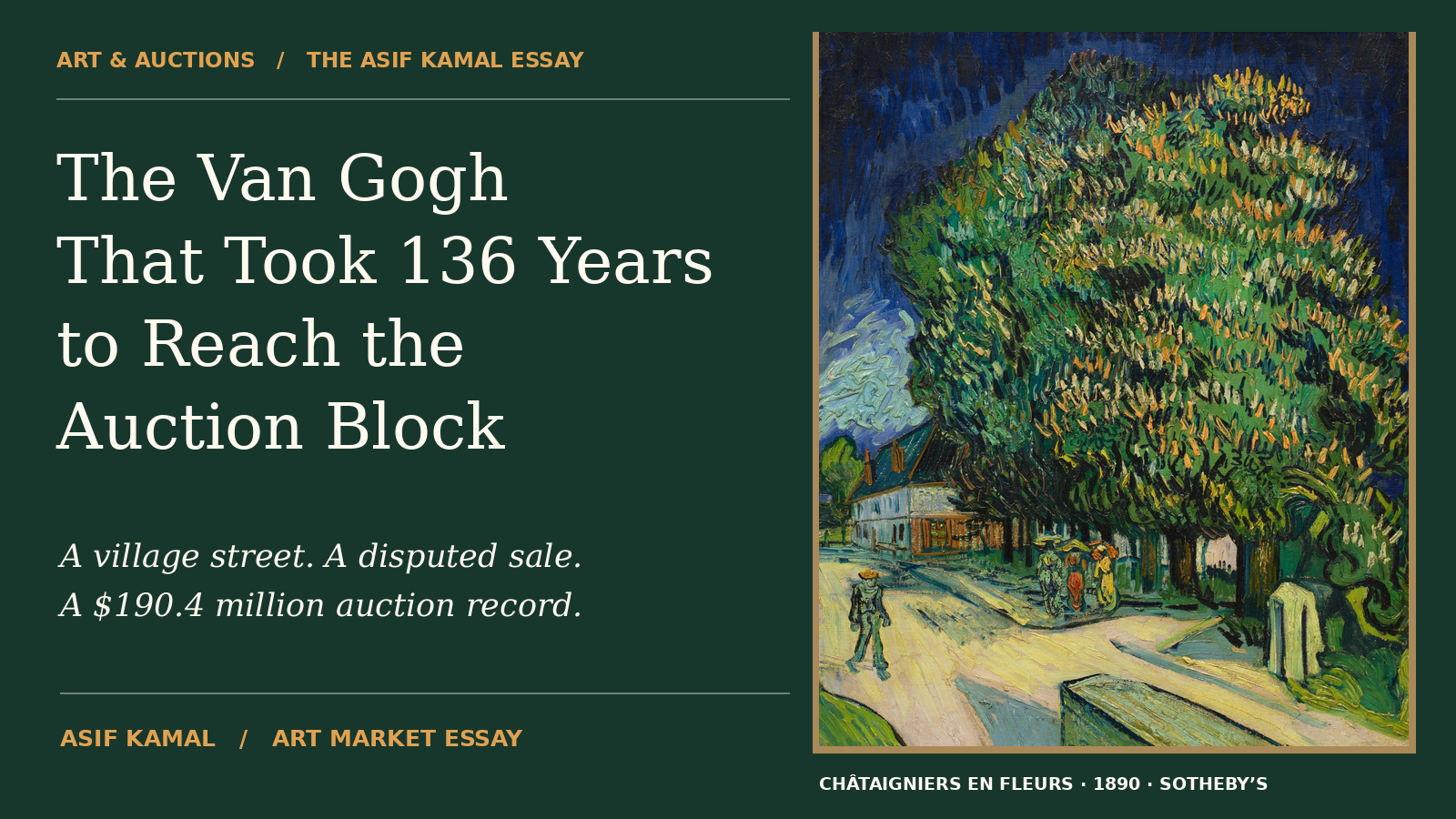
Painted on a village street in 1890, entered in a collector’s ledger for 3,800 francs in 1909, and sold for $190.4 million in New York. The most revealing number in the story may be 1936.
On 25 May 1890, Vincent van Gogh wrote to Theo and Jo from Auvers-sur-Oise. He thanked them for the fifty francs they had sent. His trunk had not arrived. Neither had the beds. He had, however, already made two studies of flowering chestnuts, one pink and one white, and was planning to paint at Dr Gachet’s house the following Tuesday. Van Gogh’s letter, 25 May 1890
One of those chestnut paintings, Châtaigniers en fleurs, came up for its first public auction at Sotheby’s in New York on 18 November 2026. It hammered at $165 million and sold for $190.4 million including fees, setting a new auction record for Van Gogh. The letter is full of things that have not arrived yet. The painting would take more than a century to arrive at a rostrum. Sotheby’s auction replay · Sale reporting
A village street, not a farewell
Sotheby’s dates the 70 × 58 cm oil on canvas to 24 May 1890, four days after Van Gogh arrived in Auvers. He had left Saint-Rémy and would spend the last ten weeks of his life in this village near Paris. Knowing what happened in July can make every Auvers picture look like a farewell. His letter suggests something more ordinary and, to me, more interesting: a man sizing up a new place, noticing its houses and gardens, and working out what to paint next. Sotheby’s lot 5 · Van Gogh Museum: his final months
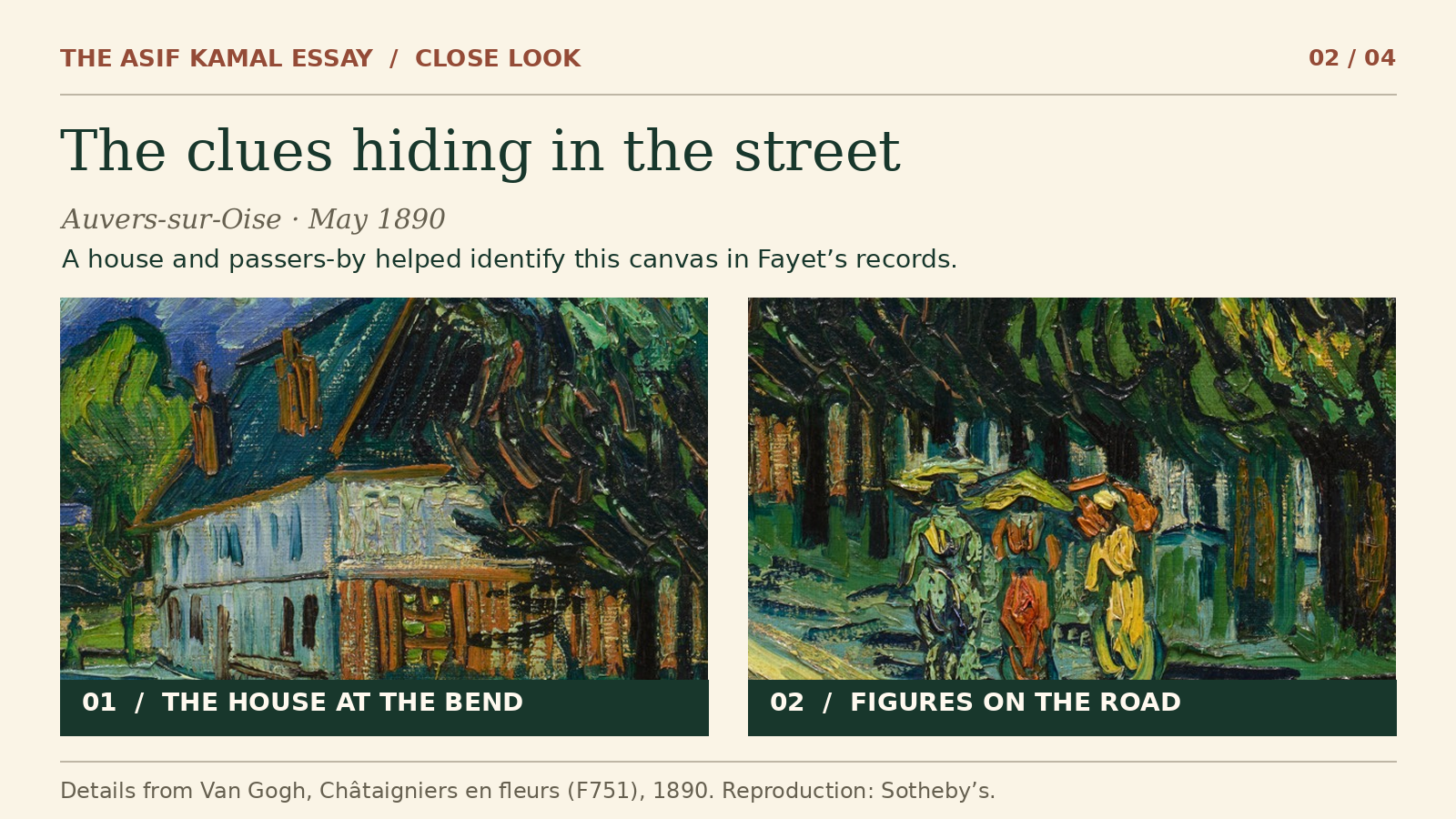
The picture is full of that attention. A house and the people on the road keep the flowering tree in the world of everyday life. Those small figures matter for another reason: they help distinguish this canvas from the similarly titled chestnut painting in the Kröller-Müller Museum, where there are no passers-by. More than a century later, the house and the people would also help identify the painting in an early collector’s records. Kröller-Müller collection · The Fayet archival discovery

The woman who put it in front of the public
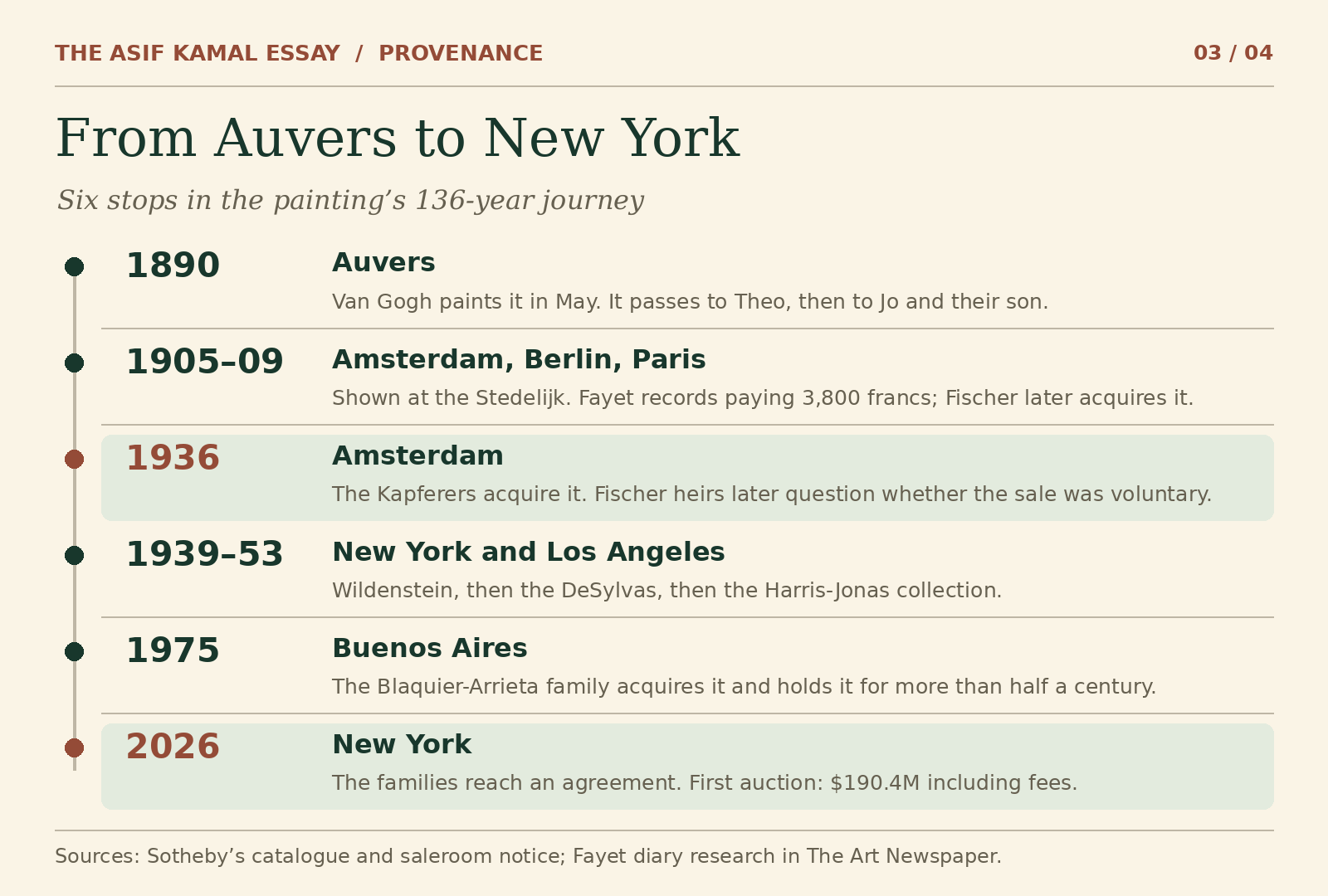
The canvas passed first to Theo and then to his widow, Johanna van Gogh-Bonger, and their son Vincent Willem. Jo inherited a daunting responsibility: she had a young child and a body of work whose standing was far from assured. She arranged loans and exhibitions and eventually published Vincent’s letters. This painting appeared at Galerie Vollard in Paris in 1896–97 and at the Stedelijk Museum in Amsterdam in 1905, listed as Dorpsplein met bloeiende kastanje (Village Square with a Flowering Chestnut). The Berlin dealer Paul Cassirer acquired it that September; the Prince de Wagram followed in 1906. Van Gogh Museum on Jo · 1905 Stedelijk catalogue, no. 226 · Catalogue provenance and exhibition history
Then there is a wonderful piece of evidence: in his diary for 9 January 1909, the French collector Gustave Fayet recorded paying the dealer Eugène Druet 3,800 francs for the painting. Fayet’s ownership had gone unrecorded in the Van Gogh literature until research for the Fondation Louis Vuitton’s 2026 exhibition. By November 1909, the painting had passed to Bernheim-Jeune, the Paris gallery from which the Berlin publisher Samuel Fischer acquired it. The diary makes for a better story than any calculation of returns across 117 years. It shows how an exact date, a dealer’s name and a few words about the subject can recover a missing chapter in a painting’s life. Fayet’s diary and provenance research · Fondation Louis Vuitton exhibition
The line in the catalogue that nearly stopped the sale
Samuel Fischer died in 1934, and the painting passed to his widow, Hedwig. It had been deposited with Paul Cassirer’s Amsterdam gallery in 1932 or 1933 by their son-in-law, Gottfried Bermann Fischer. In 1936, Henriette and Marcel Kapferer acquired it through that gallery. The deposit and the sale were separate events, years apart. According to the publisher’s own history, Nazi censorship disrupted the firm from 1933; the business split in 1936, when Gottfried moved to Vienna to continue publishing authors including Thomas Mann. S. Fischer publishing history That distinction mattered when the Fischer heirs questioned whether the 1936 transaction had taken place under duress amid Nazi persecution. Days before the auction, their representative sought a delay. Sotheby’s catalogue · Reporting on the Fischer claim
On the eve of the sale, Sotheby’s announced an agreement between the Blaquier-Arrieta family and the Fischer heirs. The lot went forward under that agreement. The terms were not disclosed, and the public notice does not amount to a ruling on the circumstances of the 1936 sale. A provenance can identify the seller, the buyer and the intermediary without answering the harder question: how free was the seller to say no? Sotheby’s saleroom notice · Settlement reporting
A record, and what it measures
After the Kapferers, the painting travelled through Wildenstein in New York to Hollywood producer George “Buddy” DeSylva and his wife Marie, and then to New York collector Harriet Harris-Jonas. It was shown at the Met and the Art Institute of Chicago in 1949–50 and at the Guggenheim in 1964. The Argentine Blaquier-Arrieta family acquired it in 1975 and held it for more than half a century. For a work with such an active early exhibition history, its long absence from public view was part of the event when it reappeared. Exhibition and ownership record · History of the collection
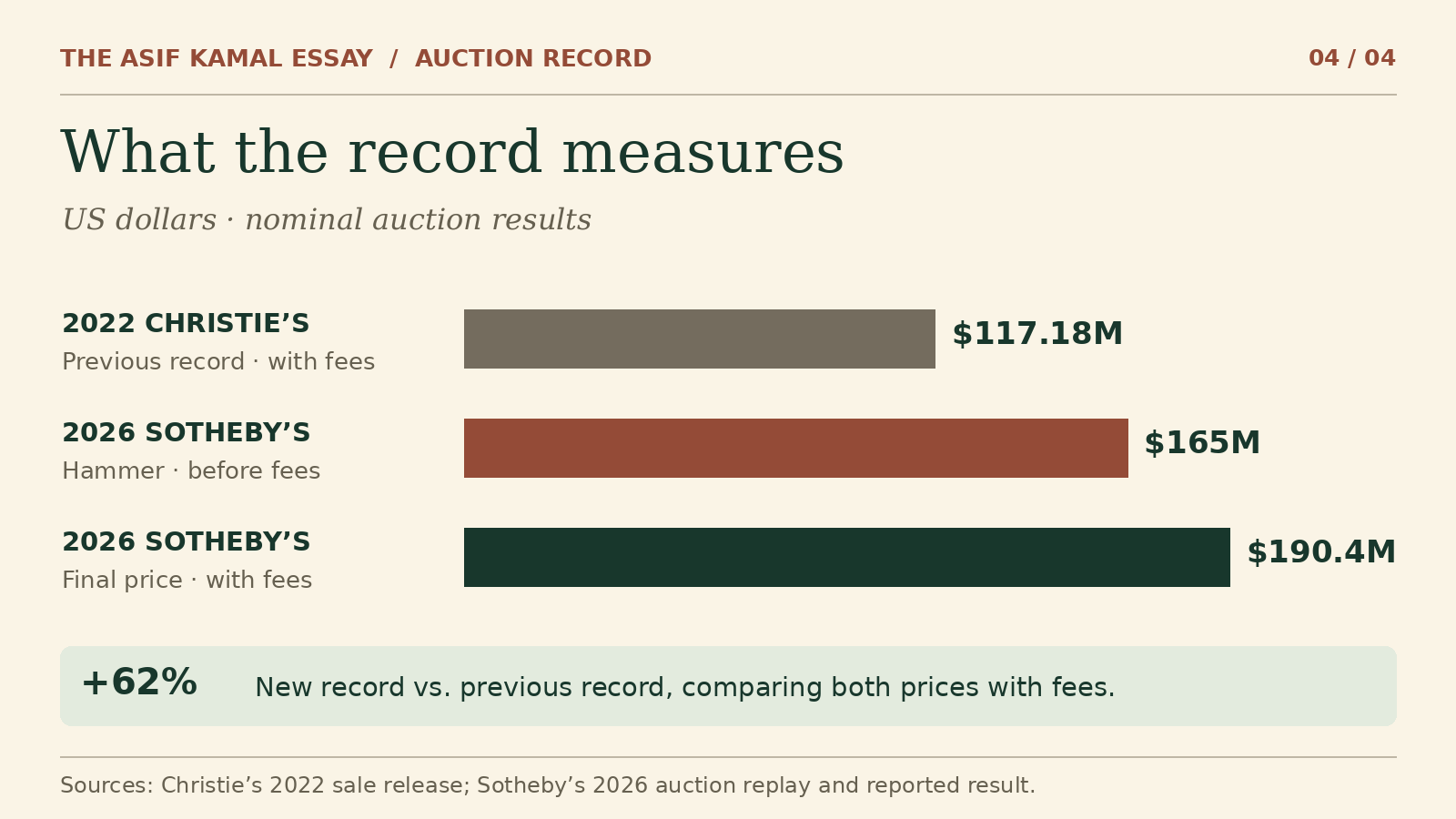
The headline number needs one distinction. The widely reported $180 million expectation was before fees, so the $165 million hammer fell short of it. The $190.4 million total nonetheless beat the previous Van Gogh auction record, $117.18 million, set by Verger avec cyprès at Christie’s in 2022. On the same basis, including fees, that is an increase of about 62% over the old record. Sotheby’s also disclosed a guarantee and an irrevocable bid. Those details are part of how the sale was structured, and they belong alongside the headline. Sotheby’s lot disclosures · 2026 result and reported estimate · Christie’s 2022 result
I keep coming back to the passers-by. Van Gogh could have painted the tree and left them out. Fayet noticed them when he described the work, and a century later those figures helped researchers link a collector’s ledger to the right canvas. The price tells us what the painting commanded on one November evening. The people on that road helped us recover part of the story of how it got there.