Three months after her death, a red net painting from 1960 became the most expensive Kusama ever sold. The price is the end of a 33-year climb, from $59,700 in 1993 to $15.1 million.
The record: No. 3P.B. at Sotheby's, 16 November 2026
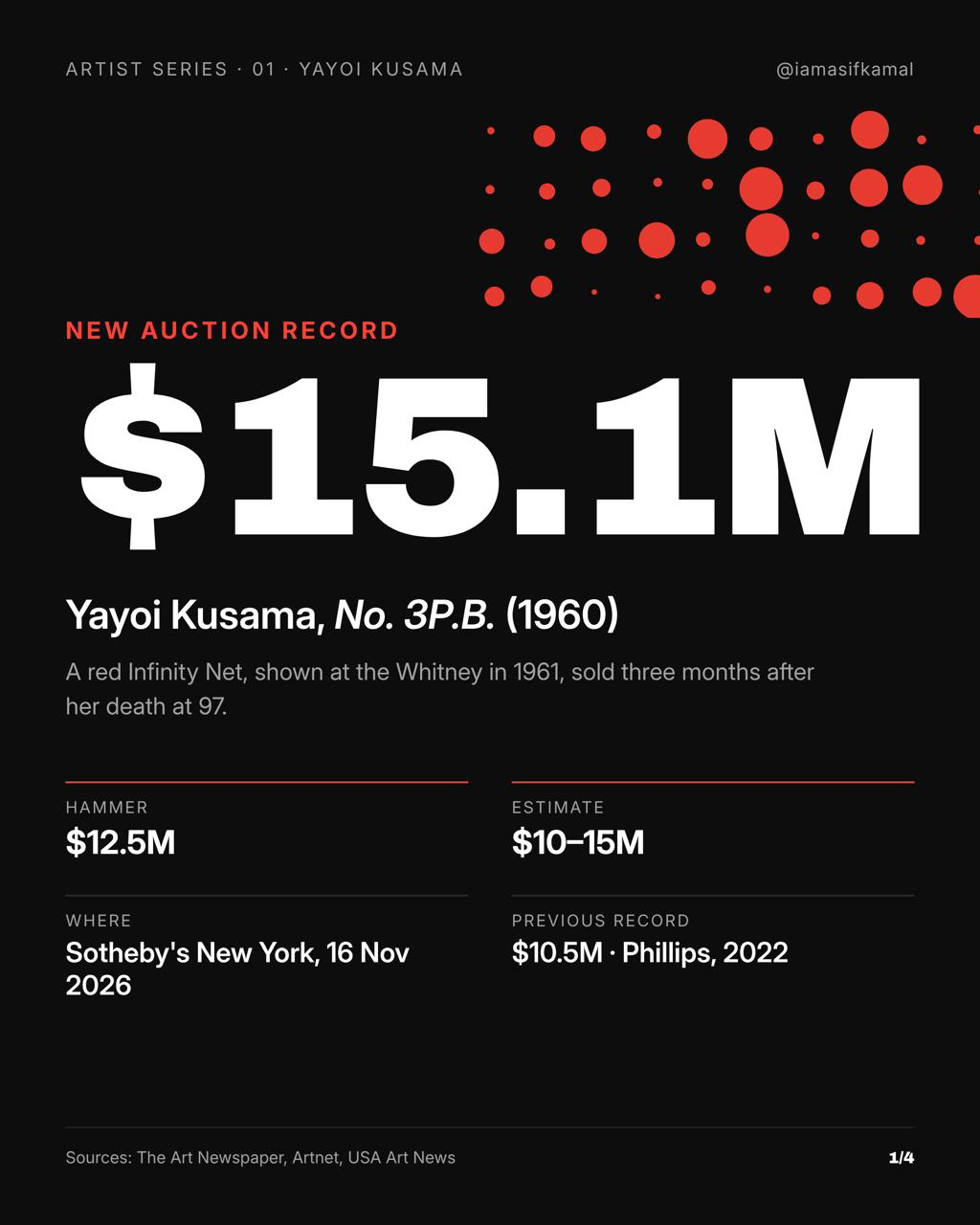
On Monday night in New York, Sotheby's sold Yayoi Kusama's No. 3P.B. (1960) for a $12.5 million hammer, or $15.1 million with fees. The estimate was $10–15 million. It was the first new Kusama record since she died on 14 August 2026, aged 97.
The work: a large crimson Infinity Net, over five feet tall, covered in thousands of looping brushstrokes over a dark ground. Kusama painted it two years after arriving in New York.
Pedigree: it hung in the Whitney Museum's 1961 annual painting exhibition, the forerunner of the Whitney Biennial, one of her first showings in an American institution.
The contest: 10 bids over four minutes between two phone bidders. Evelyn Lin, Sotheby's chairman of modern and contemporary art in Asia, beat Lisa Dennison, chairman of the Americas. Tom Eddison took the bids.
The jump: it beat her previous record, Untitled (Nets) (1959), $10.5 million at Phillips New York in May 2022, by roughly 40%.
Since her death, nearly 30 Kusama works have come to auction at Sotheby's, Christie's and Phillips. Eleven more were scheduled for the same New York week.
Early reports varied between $14.7 million and $15.1 million with fees; Sotheby's final figure and most trade outlets give $15.1 million. HENI's database lists a 2023 Hong Kong sale at Est-Ouest Auctions ($10.71 million) as the prior record, but the major trade press counts the 2022 Phillips result.
Matsumoto, 1929–1957: painting to survive
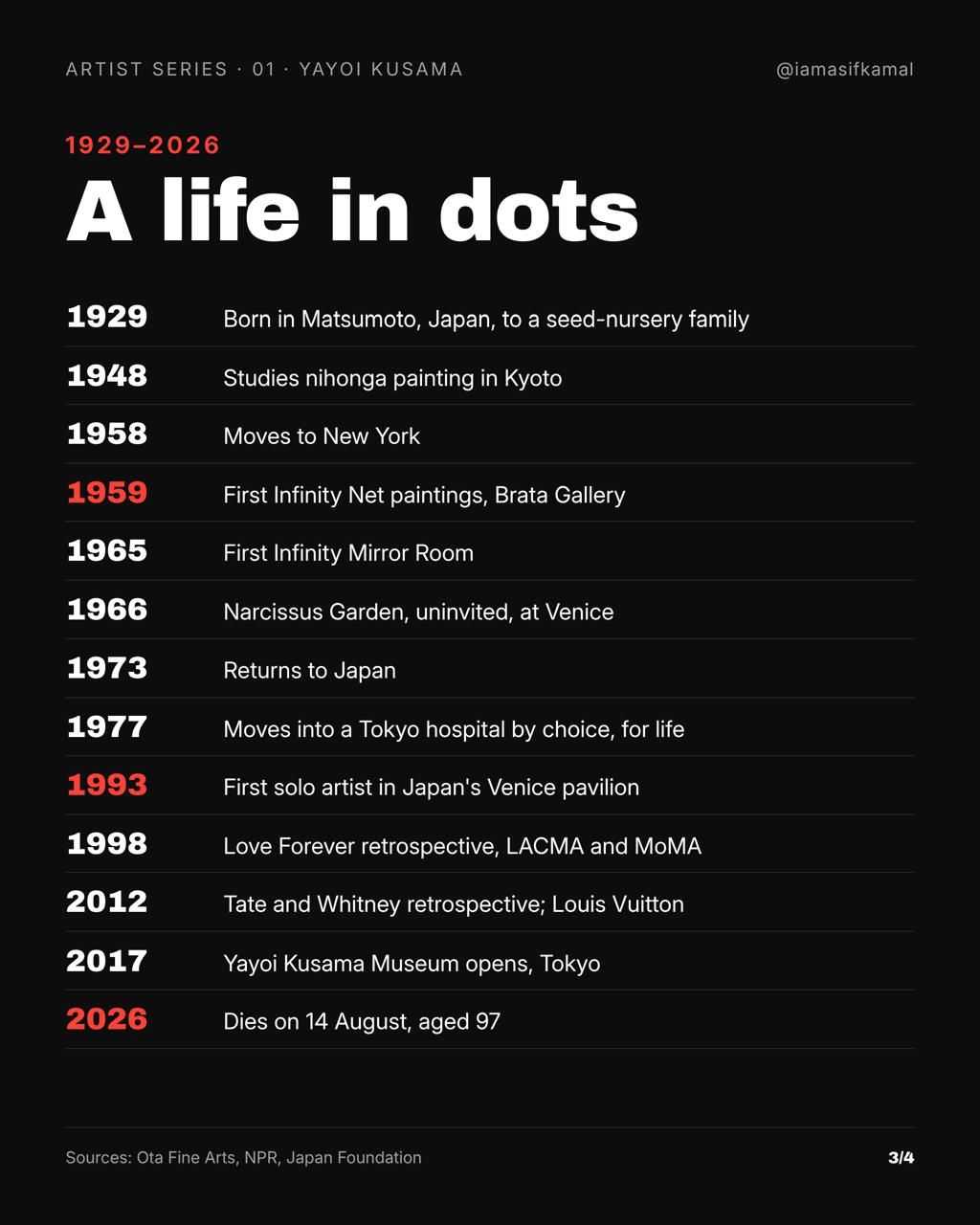
Kusama was born on 22 March 1929 in Matsumoto, Nagano, the youngest of four children in a prosperous family of seed-nursery merchants. Her parents' marriage was arranged and unhappy, and her mother opposed her becoming an artist.
The hallucinations began in childhood. The best-known story: staring at a red flower- patterned tablecloth, she saw the pattern spread across the ceiling, the walls and her own body. She drew the visions to ease the fear; her mother took the art supplies away. During the war she worked long shifts in a parachute factory as a schoolgirl.
1945: a work selected for the All Shinshu Art Exhibition, at 16.
1948: studies nihonga, traditional Japanese painting, at the Kyoto Municipal School of Arts and Crafts. She found its rigid master-disciple system stifling.
1952: first solo show, in Matsumoto; 1954: first in Tokyo.
c. 1955: finds a book of Georgia O'Keeffe's paintings in a secondhand shop and writes to her. O'Keeffe warns that an artist's life in America is hard, but encourages her to come.
Kusama later said Japan felt too small, too feudal and too scornful of women. In 1957 she left, aged 28.
New York, 1958–1973: the avant-garde years
After a first US show in Seattle in 1957, Kusama reached New York in 1958, poor and painting through the night. Within 15 years she had invented three of the forms that drive her market today.
1959, Infinity Nets: her first New York solo show, at Brata Gallery, showed huge canvases covered edge to edge in tiny looped strokes. Donald Judd, then a critic, reviewed it warmly. No. 3P.B., the new record, belongs to this first burst.
1960: the nets reach Europe in Monochrome Malerei at Leverkusen.
1962–63, soft sculpture: furniture and boats covered in stuffed fabric phalluses; Aggregation: One Thousand Boats Show (1963) was her first installation. Claes Oldenburg and Andy Warhol were showing alongside her, and she long felt they borrowed her ideas.
1965, the first Infinity Mirror Room: Phalli's Field, a mirrored room of red-spotted forms that seemed to repeat forever.
1966, Narcissus Garden: uninvited at the Venice Biennale, she laid out 1,500 mirror balls and sold them for $2 each until organisers stopped her.
1967–69, happenings: naked performers painted with dots in public places, anti- Vietnam War protests, an open letter to Nixon, a fashion boutique, and the film Kusama's Self-Obliteration (1968), which won festival prizes.
The stunts made her famous in the tabloids but not rich. Critics called it self-promotion, sales were thin, and her health suffered. In 1973 she went home.
Tokyo, 1973–1998: the hospital and the comeback
Back in Japan, Kusama was largely forgotten. She tried art dealing, which failed, and suffered a breakdown. In 1977 she checked herself into the Seiwa Hospital in Tokyo, and lived there by choice for the rest of her life. Each day she walked to a studio nearby.
She kept working in every medium. Her first novel came out in 1978, and in 1983 one of her novellas won a new-writers literary award. By 1979–80 pumpkins and small mirror rooms were back in her shows.
The revival came in two steps:
1. 1989: a retrospective at the Center for International Contemporary Arts in New York reintroduced her to the West.
2. 1993: she represented Japan at the 45th Venice Biennale, the first solo artist ever given the Japan Pavilion. Her Mirror Room (Pumpkin) filled a mirrored box with dotted pumpkins. It was 27 years after she had been chased off the lawn with her mirror balls.
The outdoor Pumpkin sculptures followed in 1994. Then Love Forever: Yayoi Kusama 1958– 1968 opened at LACMA in 1998 and toured to MoMA, the Walker and MOCA Tokyo. That show fixed her place in art history. In 1998 her New York gallery prices still ran from about $5,000 to $85,000.
1998–2026: from rediscovery to global brand
After Love Forever, recognition turned into mass popularity. Kusama became the rare artist who is at once a museum classic, a luxury brand and an Instagram backdrop.
Honours: France's Ordre des Arts et des Lettres (2003), the Praemium Imperiale for painting (2006), Person of Cultural Merit (2009) and Japan's Order of Culture (2016).
Retrospectives: Reina Sofía, Centre Pompidou, Tate Modern and the Whitney (2011– 12); tours across Latin America, Asia and Scandinavia (2013–15); Fondation Beyeler, Basel (2025).
Louis Vuitton: a 2012 collaboration under Marc Jacobs, then a second, near-400-piece collection in January 2023.
Crowds: in 2014 The Guardian named her the world's most popular artist by museum attendance. The Hirshhorn's Infinity Mirrors (2017), with six mirror rooms, helped draw a record 475,000 visitors to the museum over its run.
Her own institution: the Yayoi Kusama Museum opened in Tokyo in 2017.
New work to the end: the My Eternal Soul paintings, begun in 2009, continued into her final years.
The record has one shadow. In 2023 she apologised for racist depictions of Black people in her 2002 autobiography, Infinity Net.
Kusama died of multiple organ failure in a Tokyo hospital on 14 August 2026, aged 97. Her museum said she painted until her final days. David Zwirner, which had represented her since 2013, called it a privilege of his life to represent her.
The price move, 1993–2026: about 250 times
Kusama's auction record has been broken 12 times since 1993. Each new record tracks a step in her institutional reputation, then in her reach into Asia.
HENI auction-record database (1993–2022); Sotheby's and Artnet for Nov 2026. Excludes a disputed $10.71m Est-Ouest Hong Kong sale (2023).
The climb falls into three phases:
1. 1993–2004, the rediscovery discount. Venice and MoMA restored her reputation, but records stayed under $250,000. In 1998 her New York galleries still priced new work at $5,000–$85,000.
2. 2005–2014, the institutional re-rating. Early nets crossed $1 million in 2005, a near- fivefold jump in one sale. The Tate and Whitney retrospectives of 2011–12 confirmed the 1959–60 paintings as her blue chips.
3. 2015–2026, Asia and the pumpkin. In 2000–01, US and UK salerooms took 78% of her auction turnover. By 2021, 74% came from Asia, with Hong Kong her largest market. Her bronze Pumpkin (L) set a sculpture record of HK$62.63 million (about $8 million) at Sotheby's Hong Kong in 2023.
Volume matters as much as peaks. In 2021 her auction turnover hit about $178 million, making her the first woman in Artprice's global top 10. Hiscox ranked her the top-selling contemporary artist of 2023. Then the market cooled: turnover fell to $130.5 million in 2024 and $52.1 million in 2025.
Death reversed that. Nearly 30 works came to auction within three months. In September two pumpkins made about $7.7 million and $7.4 million in Hong Kong, and in November the 1960 net broke the record.
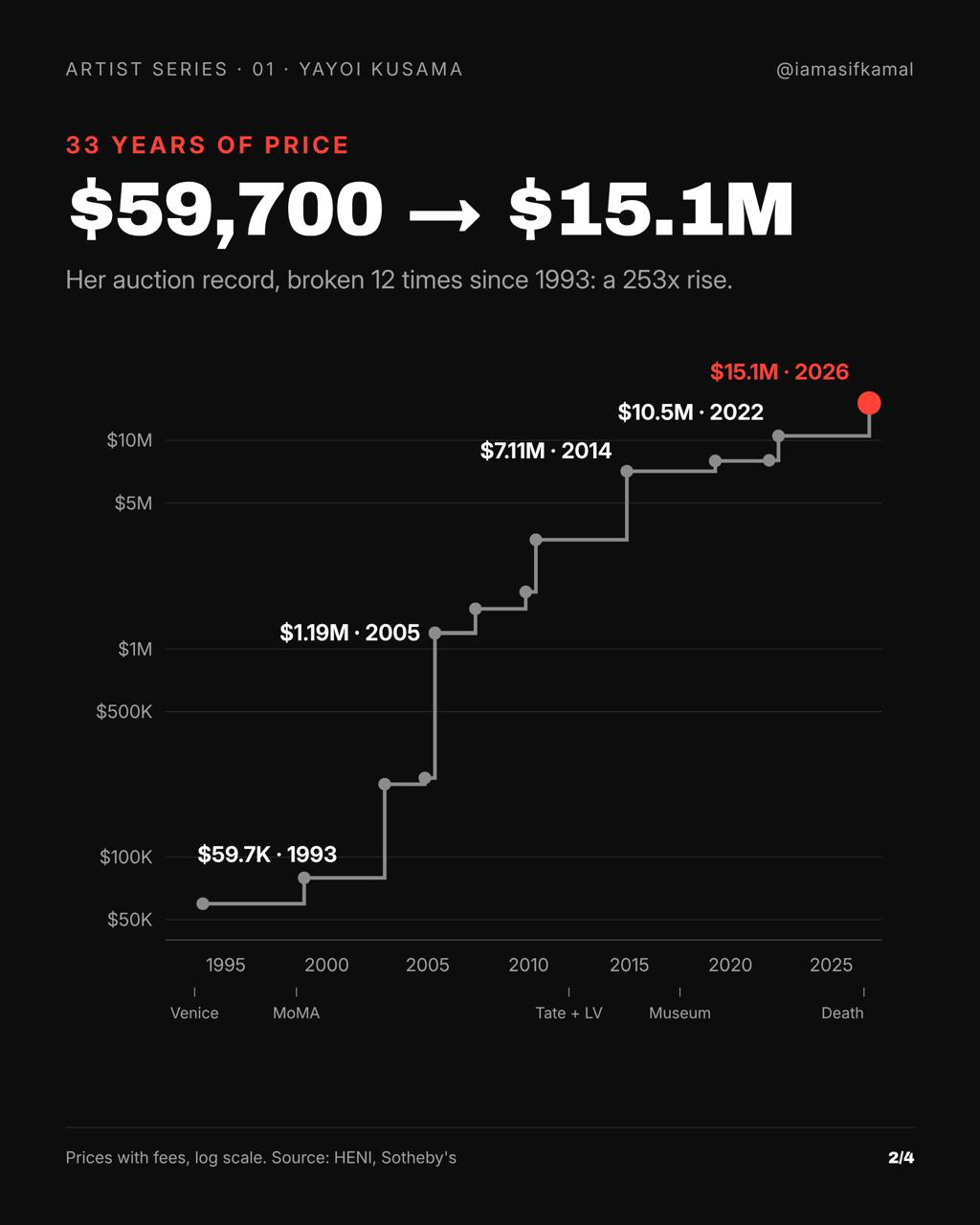
These records concern different artworks and do not represent the investment return on a single painting.
What the Kusama curve teaches
The top of her market was set by paintings she made in 1959–60, before she was famous. Five lessons travel beyond Kusama:
1. Early and exhibited wins. Every record since 2010 but one (a 2013 pumpkin) is a 1959– 60 net painting, and the new record carries 1961 Whitney provenance. Fame from later work flows back to the scarce early pieces.
2. Museums move first, prices follow. Venice (1993) and Love Forever (1998) came twelve and seven years, respectively, before the first $1 million result in 2005. The 2011–12 Tate and Whitney tour came two years before the $7.1 million record.
3. A new buyer base re-rates an artist. The shift from New York to Hong Kong, Tokyo and Seoul, plus the pumpkin as an accessible icon, built the volume of 2021–23.
4. Volume cuts both ways. Kusama is the most-traded woman at auction, with thousands of lots including prints and late series. That depth fed the record turnover years and the sharp 2024–25 cooling.
5. Death splits the market. Supply rushes in, and only the rarest works set records. Late and editioned works face more competition, not less.
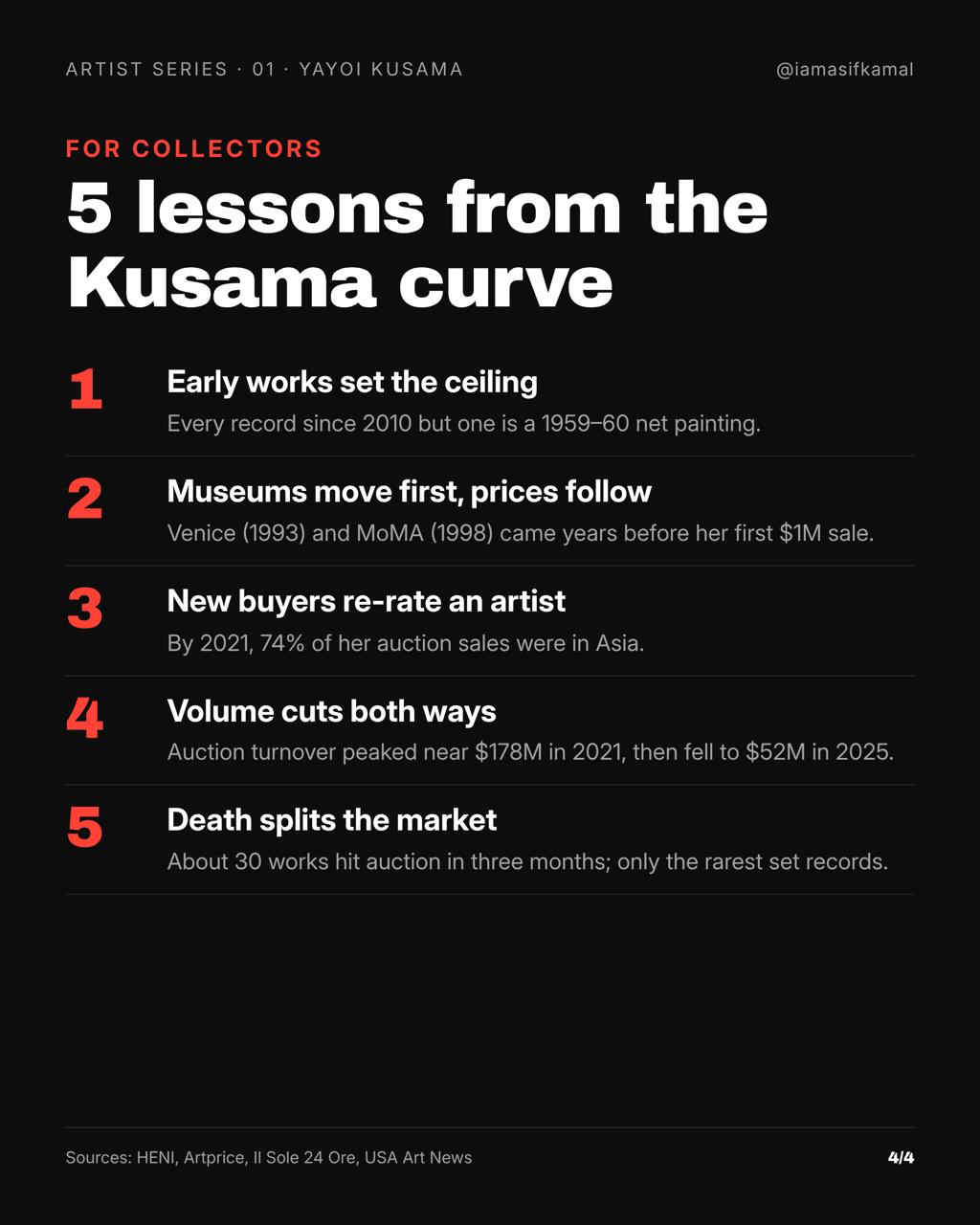
Timeline detail: Venice (1993) and Love Forever (1998) preceded the first $1 million result in 2005 by twelve and seven years, respectively.
Sources and further reading
- The Art Newspaper: November 2026 auction record
- USA Art News: auction report
- Artnet: November 2026 auction results
- HENI: auction-record progression
- NPR / OPB: obituary
- Artlyst: obituary
- Ocula: obituary
- Ota Fine Arts: chronology
- Sotheby’s: 21 facts about Yayoi Kusama
- Japan Foundation: 1993 Venice Biennale
- The Art Newspaper: 1998 comeback
- Hirshhorn: Infinity Mirrors attendance
- David Zwirner: Louis Vuitton collaboration
- Artprice: global top ten
- Artprice: 2021 report
- The Japan Times: 2023 auction market
- Il Sole 24 Ore: Kusama market
- The Value: 2023 sculpture record
- NGV: biographical chronology