Estimated reading time: 9 minutes
The question every reserve has to answer
In my last two essays I wrote about the Indian art market breaking records, and about art becoming collateral, a working asset rather than a picture on a wall. Both pieces led to the same question, and it is the one I want to take on here: what should a serious reserve actually hold?
For most of history the answer was simple. You held what could not be made in a hurry. Gold, land, great works of art. Paper money came and went, empires printed and devalued, and the people who kept their wealth were the ones who held something scarce.
That principle hasn't changed. What has changed is that scarcity now comes in two forms. One is physical: a Tyeb Mehta or a Raja Ravi Varma that will never be painted again. The other is digital: Bitcoin, whose supply is capped at 21 million coins by code that no central bank can override.
Most investors treat these as two different worlds. Art belongs to collectors, auction houses and private banks. Bitcoin belongs to traders, technologists and, increasingly, corporate treasurers. My argument in this essay is that they belong in the same conversation, and in the same reserve. That idea is the thesis behind ArtBit, a proposition I have been developing for a long time.
Two forms of scarcity, one idea
On the surface, a painting and a cryptographic network could not look more different. One hangs in a climate-controlled room; the other runs on thousands of computers around the world. But look at what makes each valuable and the overlap is striking.
Both have a supply nobody can increase. M.F. Husain is not painting any more canvases. Bitcoin's issuance is fixed by its protocol, and roughly every four years the rate of new supply halves until the 21 million cap is reached. In both cases the market cannot respond to higher demand by making more. Price is the only thing that can move.
Both sit outside the banking system's balance sheet. Neither is someone else's liability. A bond depends on the issuer paying; a deposit depends on the bank. A great painting or a bitcoin held in proper custody depends on no one's promise.
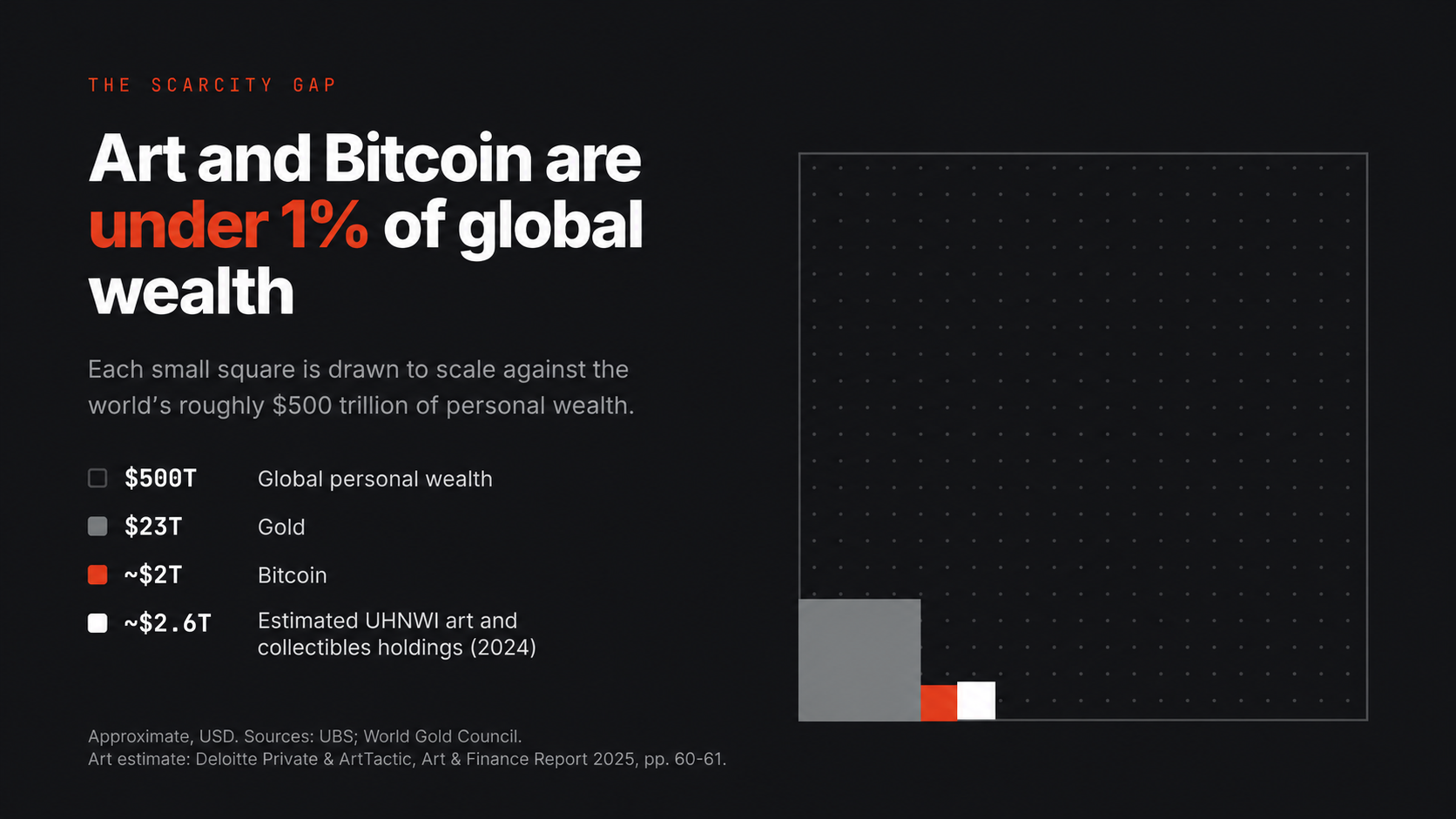
Both are tiny compared to the wealth they could protect. Global personal wealth is somewhere around $500 trillion. Gold is worth roughly $23 trillion. Bitcoin is in the region of $2 trillion. Deloitte Private and ArtTactic estimate that ultra-high-net-worth individuals held $2.564 trillion in art and collectibles in 2024. Together, the world’s two newest-and-oldest scarcity assets are a rounding error in global portfolios: under 1% of the wealth they could anchor.
Where they differ is just as important, and this is the heart of the argument:
| Museum-grade art | Bitcoin | |
|---|---|---|
| Supply | Finite, no new supply | Fixed at 21 million |
| Liquidity | Low turnover, sold over months | Deep, global, 24 hours a day |
| Volatility | Lower | Much higher, 3-5× the S&P 500 |
| Correlation to equities | Low, around 0.12 (1985-2020) | Rising, at times above 0.8 since spot ETFs |
| Role | Preserving purchasing power | Long-term monetary upside |
Art has a long record of holding value when paper money loses it. During the inflation of the late 1970s, one widely cited art index rose about 130% in five years while US consumer prices rose about 80%. Contemporary art compounded at around 13.8% a year between 1995 and 2021 against 10.2% for the S&P 500, though selection bias means that gap should be taken with care. The stronger case for art is not the return; it is the low correlation.
Bitcoin has delivered the strongest long-term appreciation of any major asset, with a trailing-decade average annual return near 49%. It has also fallen more than 60% in more than one year. Anyone who tells you Bitcoin is a quiet store of value has not held it through a drawdown.
Why hold them together
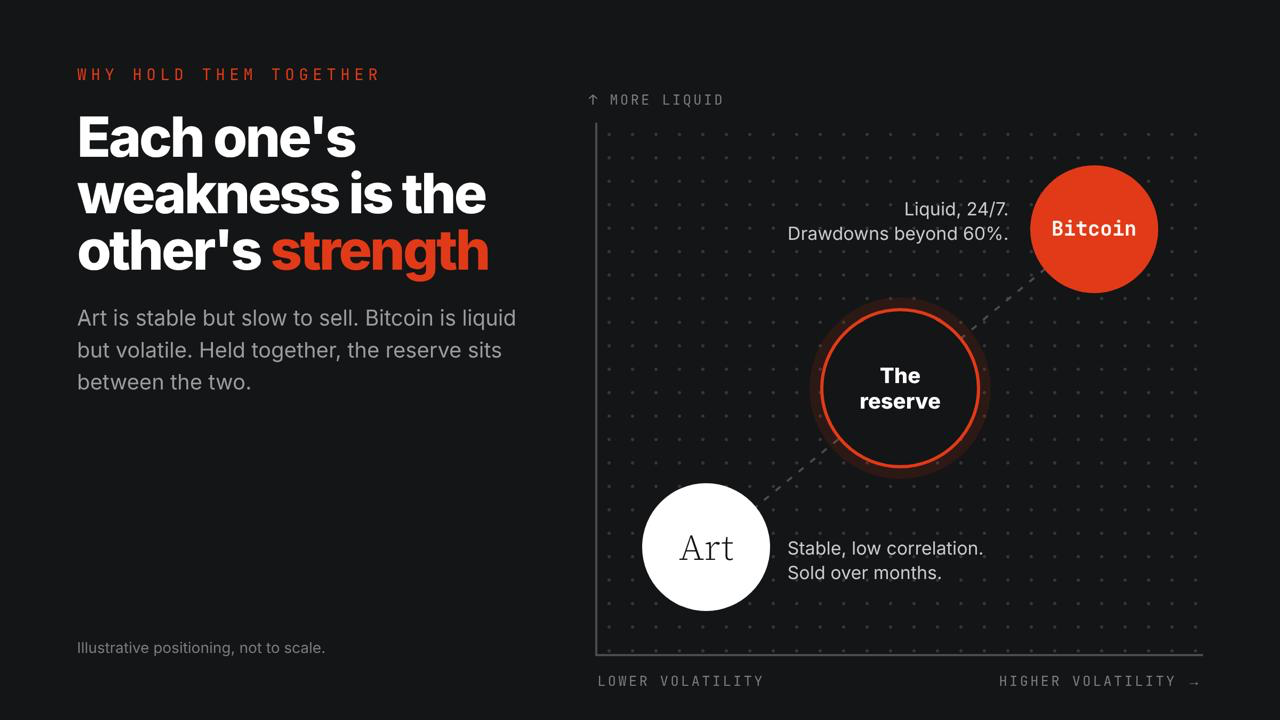
If you hold only art, you own something that keeps its value but can take months to sell. If you hold only Bitcoin, you own something you can sell in seconds but that can lose half its value in a year. Each asset's weakness is the other's strength.
Put them in one reserve and three things happen:
- Liquidity balances out. Bitcoin gives the reserve a liquid leg that can meet redemptions, rebalancing or opportunities without a forced sale of a painting. Art gives the reserve a long-duration anchor that doesn't need to trade.
- Volatility is tempered. Art's low correlation means a Bitcoin drawdown doesn't drag the whole reserve down with it. At the level of the overall sleeve, the swings are more moderate than either asset on its own.
- The thesis stays intact. Whichever way the cycle turns, everything in the reserve is scarce. You are not diluting the idea with assets that can be printed.
This is not a theoretical conversation any more. Bitcoin has moved from the fringes into institutional balance sheets. US spot Bitcoin ETFs launched in January 2024. Strategy, the largest corporate holder, reported 673,783 BTC in January 2026. On March 6, 2025, the United States signed an executive order creating a Strategic Bitcoin Reserve, holding coins forfeited in criminal cases rather than buying new ones. Governments and boards are now openly asking whether Bitcoin belongs in a reserve.
Art has been in that conversation far longer, just more quietly. Families, foundations and sovereign institutions have held great collections for generations precisely because they outlast currencies and regimes. And as I argued in my last essay, art is becoming a working asset that can be verified, fractionalised and borrowed against.
What doesn't exist yet is a disciplined way to hold both scarcities together, with institutional custody, independent valuation and proper governance. That gap is what ArtBit sets out to think through.
ArtBit: a thesis in the making
I want to be clear about what ArtBit is and isn't. It is not a fund you can invest in today, and I'm not making claims about its size or structure. It is a proposition I have been working on for a long time: that museum-grade fine art and Bitcoin, physical and digital scarcity, belong together in one disciplined reserve. Think of it less as a product and more as a think tank built around one idea.
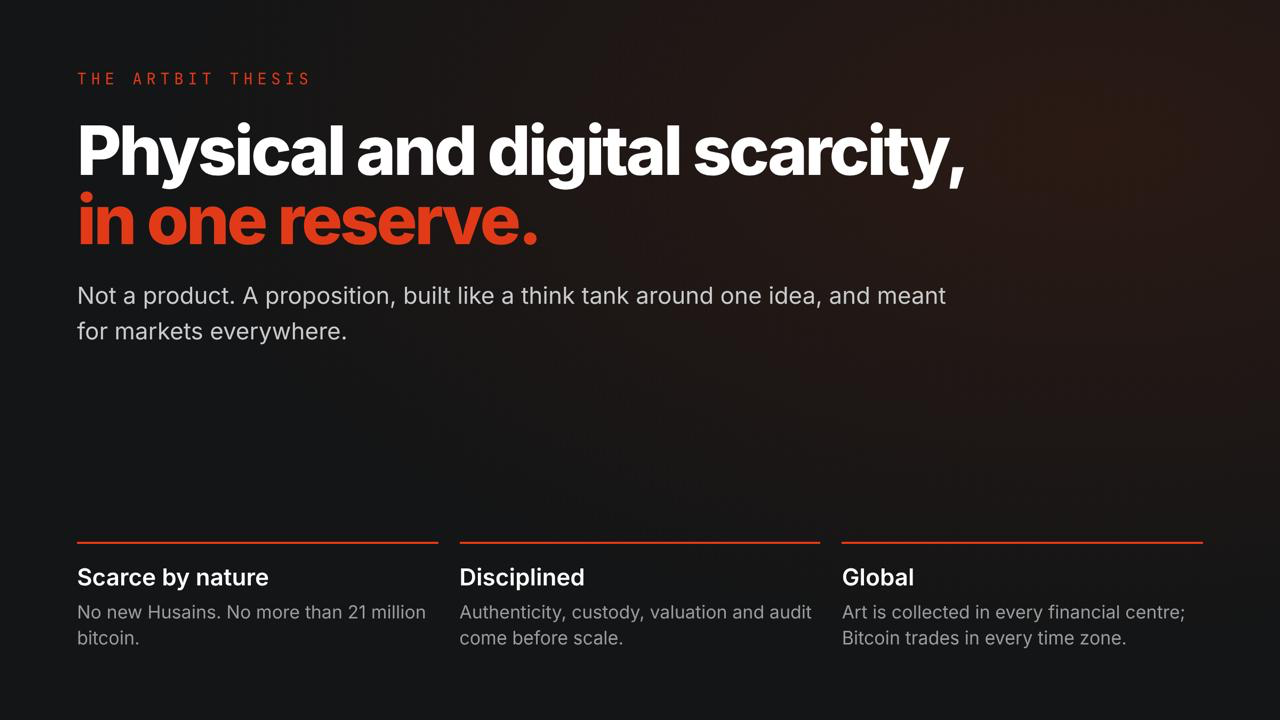
The idea is simple. A scarcity reserve would sit inside a portfolio, not replace it. A traditional portfolio of stocks and bonds might carve out a measured slice and hold it in assets that no government or company can create more of. How big that slice should be is a question for each investor and each committee, and one I want to explore in the open.
For such a reserve to be credible, a few principles matter more than any size or structure:
- Selection. Art chosen through rigorous research, not taste alone, and Bitcoin held with the same discipline.
- Authenticity and provenance. Every work authenticated, with title and provenance verified before it enters a reserve.
- Custody. Art in museum-standard storage with proper insurance; Bitcoin in secure, segregated custody where no single person holds the keys.
- Transparency. Independent valuation, audit and regular reporting across both assets.
Not every institution can hold digital assets, and the thesis doesn't pretend otherwise. One could imagine an art-weighted expression for those who can't hold Bitcoin, a balanced one where each asset tempers the other, and a Bitcoin-tilted one for those seeking more liquidity and upside. Mandates would size the pieces; the scarcity idea stays the same.
Why I think this goes global
This is not a local idea. Fine art is collected in every major financial centre, and Bitcoin trades in every time zone. Both are borderless forms of scarcity, and the questions they raise, what a reserve should hold and how to protect purchasing power across generations, are being asked by families, institutions and governments everywhere. I believe the right amalgamation of these two asset classes, physical and digital scarcity in one place, will move across markets globally. ArtBit is my attempt to think that through properly.
Where it fits in my work
ArtBit is the third piece of something I've been building for years. With Artfi and the ART-20 standard, art became something you can own digitally and in fractions. With art as collateral, it becomes something you can borrow against. The ArtBit thesis is the next step: art taking its place where it has always belonged, in the reserve, alongside the digital scarcity of our age.
The question I keep coming back to, and want to put to every allocator and collector, is this: should scarcity become a permanent part of a serious portfolio?
The honest risks
A reserve built on scarcity is not risk-free, and I'd be doing you a disservice if I pretended otherwise.
- Bitcoin is volatile. Drawdowns of 60% or more have happened, and its correlation with equities has risen since spot ETFs launched. The diversification benefit is real but it moves over time.
- Art is illiquid and hard to value. Sales are infrequent, indices suffer from selection bias, and a forced sale can take months and cost a lot.
- Custody and authenticity matter enormously. A fake painting or a lost private key is a permanent loss. That's why authentication, insurance, qualified custody and independent audit are not optional extras.
- Rules are still being written. Policy on Bitcoin reserves, in the US and elsewhere, is evolving. The US reserve has not bought any coins, and legislation to expand it has not passed.
None of these risks argue against scarcity. They argue for discipline, and discipline is what the ArtBit thesis is built around.
What comes next
In the coming essays I'll go deeper into how a scarcity sleeve should be sized inside an institutional portfolio, how museum-grade art is selected and valued, and how custody works for an asset you can hang on a wall alongside one that exists only as a cryptographic key.
ArtBit is an open conversation. If you're an allocator, a collector, a family office or simply someone who thinks seriously about scarcity, I'd like to hear from you.
Sources
- Strategy kicks off 2026 with a bitcoin buy as holdings hit 673,783 BTC – The Block
- US Strategic Bitcoin Reserve: year one – BlockEden
- UBS, Global Wealth Report; World Gold Council; Deloitte Private & ArtTactic, Art & Finance Report 2025, pp. 60-61
- Citi GPS / Citi Private Bank, using Masterworks data (art returns and correlations)
- Morgan Stanley (2025) and CME Group (2025) on Bitcoin returns, volatility and correlation
This essay is for information and discussion only. ArtBit is a proposition in development, not a fund or product on offer, and nothing here is an offer to sell, or a solicitation to buy, any security or fund interest. All investments carry risk, including loss of capital. Past performance does not indicate future results, and figures drawn from third-party research have not been independently verified.