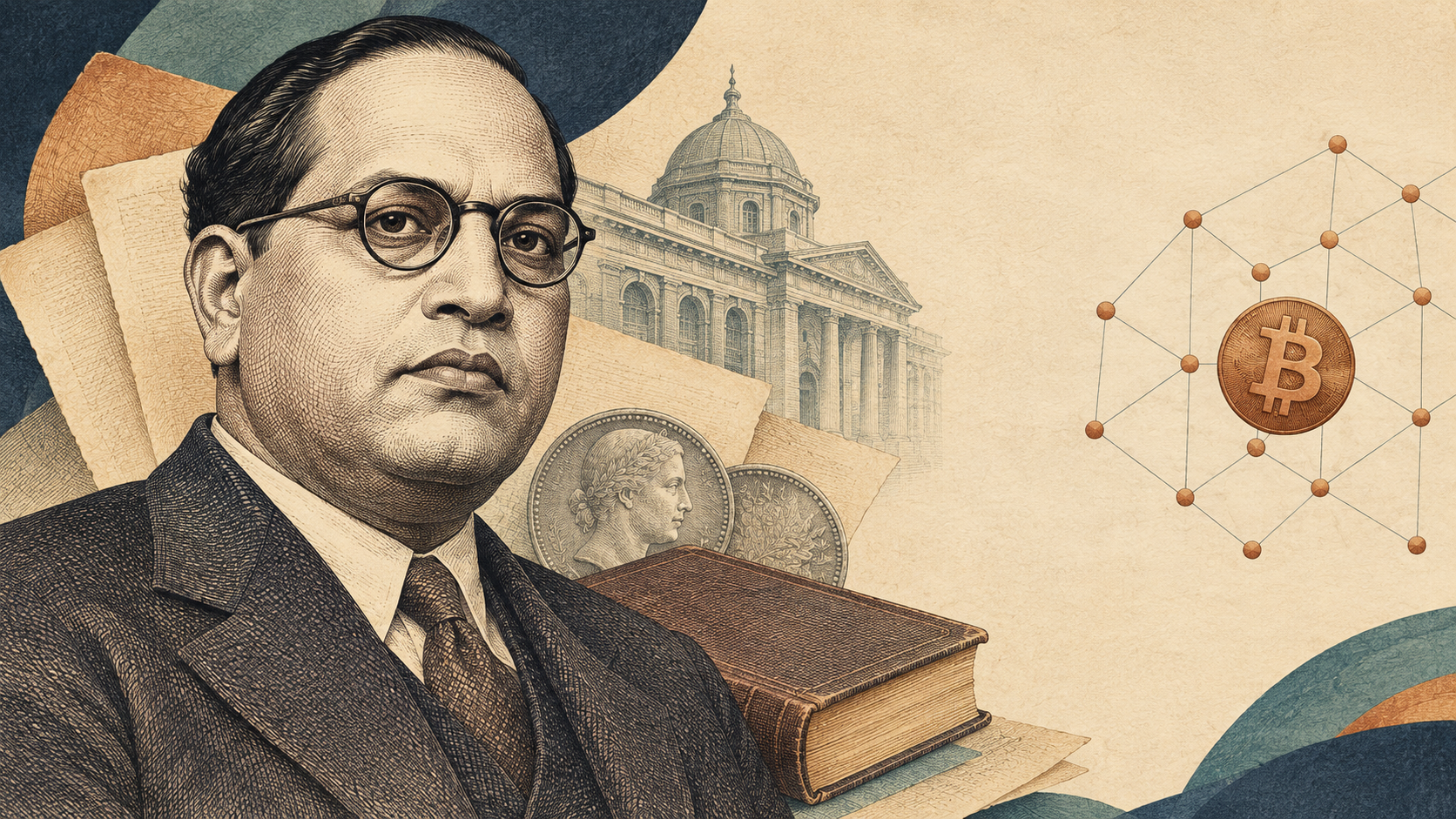
An Indian economist, a century-old monetary debate, and the remarkable philosophical connection between the rupee, gold, and Bitcoin.
By Asif Kamal | November 2026
The Discovery That Made Me Revisit Monetary History
Every once in a while, you come across an idea that makes you reconsider the history of something you thought you understood.
For me, that happened when I came across a discussion about Dr. B.R. Ambedkar and a book he published in 1923 titled The Problem of the Rupee: Its Origin and Its Solution.
The discussion was prompted by economist and Bitcoin author Saifedean Ammous, who highlighted Ambedkar’s proposal for a fixed supply of Indian rupees nearly a century before Bitcoin.
My immediate reaction was curiosity.
Could an Indian economist, writing under British colonial rule, have articulated a principle that would later become central to the world’s first successful decentralized cryptocurrency?
I went to the original text.
What I discovered was more interesting than the comparison itself.
Ambedkar was not imagining digital currency. He was not proposing decentralized networks, cryptographic consensus, or anything resembling blockchain technology.
He was addressing a much older and more fundamental economic question:
Who should have the authority to create money, and what prevents that authority from being abused?
This question was central to monetary debates in 1923. It remains central today.
And it provides a fascinating intellectual connection between Ambedkar’s economic thinking and Satoshi Nakamoto’s invention of Bitcoin.
The Ambedkar We Rarely Discuss
For most Indians, Dr. Bhimrao Ramji Ambedkar occupies an extraordinary place in history.
He is remembered as the principal architect of India’s Constitution, a champion of social justice, and one of the most consequential intellectual figures in modern India.
But Ambedkar was also a formidable monetary economist.
His academic training included economics at Columbia University and the London School of Economics. His research explored public finance, currency systems, and the economic consequences of colonial administration.
In 1923, he published The Problem of the Rupee, an extensive examination of India’s monetary history and the instability of its currency.
This was not a philosophical pamphlet or a political manifesto.
It was a technical economic investigation, examining the evolution of India’s monetary system from silver-based currency toward the gold exchange standard.
The book considered the consequences of currency depreciation, fluctuations in silver and gold, government coinage, international exchange rates, and monetary administration.
Ambedkar was trying to understand why a currency that appeared stable against another currency could still fail the people who depended upon it.
That distinction became the foundation of his argument.
A Stable Exchange Rate Is Not the Same as Stable Money

Imagine that the Indian rupee maintains a relatively stable exchange rate against the British pound.
To policymakers concerned with international trade, that may appear to be evidence of monetary stability.
But suppose the prices of food, clothing, housing, and other necessities are increasing.
The rupee may be stable in foreign-exchange terms while losing purchasing power at home.
For an ordinary household, which form of stability matters more?
Ambedkar believed this question was being inadequately addressed by the monetary authorities of his time.
He challenged the intellectual foundations of the gold exchange standard, particularly the arguments advanced by John Maynard Keynes.
Keynes had published Indian Currency and Finance in 1913, examining India’s monetary arrangements and defending important features of its exchange system.
Ambedkar disagreed with the emphasis placed on exchange-rate management.
In the preface to The Problem of the Rupee, he wrote:
“Nothing will stabilise the rupee unless we stabilise its general purchasing power.”
This is perhaps the most important sentence in the entire discussion.
Ambedkar was distinguishing the external value of money from its internal purchasing power.
The exchange rate tells us how much one currency can buy of another.
Purchasing power tells us how much money can buy in the real economy.
They are related, but they are not identical.
A monetary system can succeed at one while failing at the other.
That observation is not merely a historical curiosity.
It remains relevant whenever governments and central banks evaluate currency stability through exchange rates, inflation targets, or financial-market conditions.
The ultimate economic question is not simply whether a currency maintains its price against another currency.
It is whether that currency remains a reliable instrument for saving, exchange, and economic calculation.
The Remarkable Proposal: Limit the Supply of Rupees
This is where Ambedkar’s argument becomes especially interesting from a modern perspective.
His proposed solution was not simply to strengthen the currency’s connection to gold.
He wanted to constrain the government’s ability to expand the stock of rupees.
In his preface, he proposed an inconvertible rupee with a fixed limit of issue.
He even considered replacing metallic rupees with inconvertible paper currency, although he acknowledged that this might be considered too radical.
His essential recommendation was unmistakable.
The government should not possess an unrestricted ability to create additional rupees.
He argued that the mints should be closed not only to private individuals but also to the government itself.
That second restriction is particularly important.
Preventing private citizens from minting currency is relatively straightforward.
Preventing the sovereign authority from expanding the currency supply requires a much stronger commitment.
It means placing monetary discipline above the convenience of the administration.
Ambedkar’s preferred system would retain gold as legal tender while fixing the stock of rupee currency.
Gold could enter the monetary system through its own coinage arrangements, but the rupee supply would not be continuously enlarged at the government’s discretion.
This was not an absolute cap on every form of money in the economy.
It was a specific institutional proposal to restrict rupee issuance within a broader gold-based monetary system.
That historical distinction matters.
Nevertheless, the underlying principle is striking:
A currency should not depend entirely on the self-restraint of the authority empowered to issue it.
And that is where the comparison with Bitcoin begins to acquire real intellectual substance.
What Satoshi Changed 85 Years Later
On October 31, 2008, a person or group using the name Satoshi Nakamoto introduced Bitcoin through a paper titled Bitcoin: A Peer-to-Peer Electronic Cash System.
The paper proposed a mechanism for transferring value electronically without relying on a trusted financial intermediary to validate every transaction.
Bitcoin subsequently launched in January 2009.
Its design combined several important ideas: cryptographic signatures, proof-of-work, distributed consensus, transaction verification, and a predictable issuance schedule.
Bitcoin’s monetary supply is governed by protocol rules that target a maximum issuance of approximately 21 million bitcoins.
New coins enter circulation through mining rewards, which decline according to a predetermined schedule.
Unlike a conventional national currency, Bitcoin does not have a central bank that can independently decide to expand its issuance.
That is a significant institutional innovation.
Ambedkar wanted the government’s ability to create additional rupees restricted by monetary arrangements and law.
Bitcoin approaches the problem through software rules enforced by a decentralized network.
In Ambedkar’s proposed system, monetary discipline depended on institutions respecting their constraints.
In Bitcoin, issuance rules are independently verified by participating nodes, and changing those rules requires sufficient network adoption rather than a unilateral decision by a monetary authority.
The distinction can be expressed simply:
Ambedkar sought to constrain monetary power through institutions. Satoshi designed a system in which monetary issuance could be constrained through code and decentralized verification.
This does not mean Bitcoin eliminates governance, human judgment, or economic risk.
Its software can be modified, and its continued monetary credibility depends on participants rejecting changes they consider unacceptable.
But its architecture changes the relationship between monetary rules and centralized authority.
That is what makes the historical comparison worth examining.
Did Ambedkar Predict Bitcoin?
No.
And I believe we do Ambedkar’s intellectual legacy a disservice when we try to force that conclusion.
Ambedkar did not propose cryptocurrency.
He did not advocate blockchain technology.
He did not describe a peer-to-peer payment network.
Nor did he propose a universal monetary asset with a mathematically predetermined supply of 21 million units.
His monetary framework was rooted in the economic conditions of colonial India and the institutional arrangements of the gold standard.
Bitcoin emerged from an entirely different technological and economic environment.
The two proposals also address different problems.
Ambedkar was principally concerned with the stability of the Indian rupee and the consequences of monetary administration.
Satoshi’s paper focused on enabling electronic payments without relying on trusted third parties, while Bitcoin’s issuance schedule established an additional form of monetary scarcity.
Their objectives overlap, but they are not interchangeable.
It would also be historically incorrect to suggest that Ambedkar invented the principle of limited monetary supply.
Economists and monetary reformers had debated currency restrictions, metallic standards, and limits on issuance long before 1923.
Ambedkar’s contribution was his particular analysis of India’s currency system and his argument for restricting rupee issuance within that historical context.
The intellectual connection to Bitcoin is therefore not a claim of invention or direct influence.
It is a comparison between two different responses to a recurring problem in monetary economics.
And that comparison is valuable enough without exaggeration.
The Keynes–Ambedkar Disagreement Deserves More Attention
Perhaps the most overlooked dimension of this story is Ambedkar’s disagreement with Keynes.
Today, Keynes is among the most influential economists in modern economic history.
His work helped shape macroeconomics and the intellectual foundations of active fiscal and monetary policy.
Ambedkar’s criticism in 1923, however, concerned Keynes’s earlier analysis of Indian currency, not the full body of economic theory Keynes would develop in subsequent decades.
This distinction is essential.
Ambedkar was challenging the gold exchange standard and the claim that its mechanisms could adequately stabilize the rupee.
He believed that managing the currency’s external exchange value did not necessarily address the problem of domestic purchasing power.
The disagreement was technical, but it also reflected competing priorities in monetary design.
How much should a currency system depend on administrative management?
How much should it depend on structural constraints?
And what should monetary stability ultimately mean?
These questions remain relevant in modern debates between advocates of discretionary monetary policy and supporters of rule-based monetary systems.
Yet there is an important complication.
A strictly limited currency supply does not automatically guarantee stable purchasing power.
The value of money depends not only on its supply but also on demand, production, economic expectations, credit conditions, and the velocity of circulation.
A currency with a fixed supply can appreciate or depreciate substantially.
Bitcoin itself demonstrates this reality through its considerable price volatility.
Therefore, Ambedkar’s emphasis on purchasing power and Bitcoin’s supply restrictions should not be treated as proof that fixed-supply money necessarily produces stable prices.
Rather, both invite us to examine the trade-offs between monetary discretion, scarcity, and stability.
That is a far more productive discussion than declaring one monetary philosophy permanently superior to another.
Even Ambedkar’s Teacher Recognized the Importance of the Constraint
One of the most revealing passages in the original book appears before Ambedkar’s own chapters begin.
The foreword was written by Edwin Cannan, his teacher at the London School of Economics.
Cannan did not agree with much of Ambedkar’s criticism of the existing monetary system.
He said so explicitly.
But he nevertheless expressed sympathy with Ambedkar’s practical recommendation.
Cannan believed that a simpler monetary arrangement could make it more difficult for administrators and legislators to interfere with the currency.
This is an important historical detail because it shows that the debate was not merely between those who understood economics and those who did not.
Two serious economists could disagree over monetary theory while recognizing the value of limiting opportunities for administrative manipulation.
That concern extends far beyond colonial India.
The rules governing money affect everyone, yet the power to change those rules is often concentrated in a relatively small number of institutions.
A sound monetary system must therefore consider not only the intentions of those who administer it but also the incentives and powers available to their successors.
A system designed around the assumption that every future administrator will act wisely is inherently vulnerable.
The challenge is to construct institutions that remain credible even when political incentives change.
The Deeper Question: Who Owns the Rules of Money?
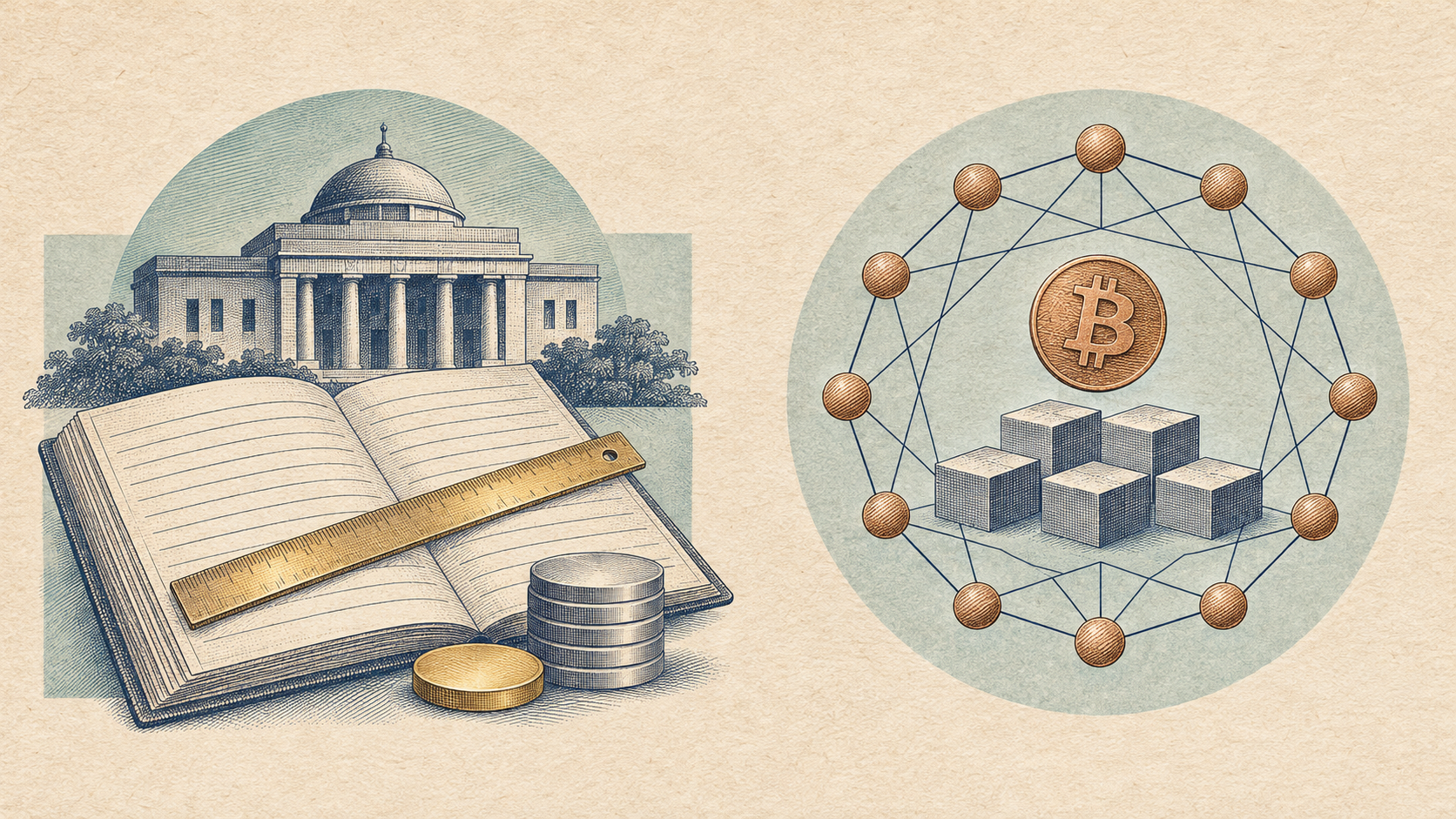
The more I reflect on Ambedkar’s work, the more I think this is the central question connecting his era to ours.
Money is not merely a medium of exchange.
It is a system of rules governing economic coordination.
Those rules influence how people save, borrow, invest, price assets, enter contracts, and transfer wealth across generations.
When monetary rules change, the consequences are distributed unevenly.
Some participants benefit from access to newly created money or credit.
Others experience changes in purchasing power, asset prices, and the real value of their savings.
This makes monetary design a question of institutional power as much as economics.
Under a sovereign fiat monetary system, monetary policy is administered through institutions with legal authority and public mandates.
Those institutions may use discretion to respond to recessions, banking crises, unemployment, and financial instability.
That flexibility can be valuable.
But discretion also creates the possibility of policy mistakes, political pressure, and the erosion of monetary credibility.
Under Bitcoin, the base asset’s issuance schedule is far more rigid.
That rigidity limits one category of monetary discretion, but it also removes the ability to adjust the supply in response to changing economic conditions.
Neither architecture is free from trade-offs.
The question is what kind of monetary system society wants, what risks it is prepared to accept, and who should possess the authority to change its fundamental rules.
Ambedkar addressed that question through monetary institutions.
Bitcoin addresses part of it through cryptography, network consensus, and an issuance protocol.
The technologies are different.
The governance problem is remarkably familiar.
From Gold to Code: What Actually Changed?
For much of monetary history, scarcity was associated with physical constraints.
Gold could not be produced by administrative decree.
Its supply depended on geological availability, mining costs, technology, and economic incentives.
That did not make gold perfectly scarce or its purchasing power perfectly stable.
But it made arbitrary expansion more difficult than issuing additional paper claims.
Bitcoin introduced a different form of scarcity.
Its supply restrictions do not depend on the physical difficulty of extracting a metal.
They depend on protocol rules, cryptographic verification, and a network of participants enforcing those rules.
In that sense, Bitcoin transforms scarcity from a predominantly physical constraint into a digitally verifiable monetary property.
This is a profound development in financial technology.
But scarcity alone does not establish value.
A scarce asset must also attract demand, demonstrate utility, sustain confidence, and survive competition.
Many things are scarce without being valuable.
Bitcoin’s economic significance lies not simply in its supply limit but in the combination of that limit with transferability, divisibility, independent verification, global accessibility, and the network that supports it.
Ambedkar’s proposal and Bitcoin therefore represent different stages in the evolution of monetary constraints.
One sought to limit currency issuance through a gold-based institutional framework.
The other established a digital monetary asset with issuance rules that can be independently verified.
The common thread is the effort to make monetary commitments more credible.
Why This Matters in 2026
We live in an era when money is becoming increasingly programmable.
Digital payments have transformed commerce.
Central bank digital currencies are being researched and developed.
Stablecoins allow representations of sovereign currencies to move across blockchain networks.
Tokenization is beginning to change how financial claims and real-world assets can be issued, transferred, and managed.
Meanwhile, Bitcoin continues to challenge traditional assumptions about monetary ownership and the necessity of centralized intermediaries.
As someone working at the intersection of technology, financial infrastructure, and asset ownership, I find this convergence particularly interesting.
For years, much of the blockchain conversation has focused on speculation, token prices, and market cycles.
But beneath those discussions lies a more consequential subject: the architecture of financial systems.
Who can issue an asset?
Who can alter its supply?
Who verifies ownership?
Who controls settlement?
Who can change the rules after participants have already committed their capital?
These are not exclusively technological questions.
They are questions about economic rights, institutional credibility, and the distribution of power.
And they existed long before the invention of blockchain.
Ambedkar’s work is a reminder that some of the most important problems confronting modern financial technology were identified by economists working with entirely different tools.
The technology may be new.
The economic questions are often centuries old.
India’s Forgotten Contribution to the Conversation About Sound Money
There is another reason I believe this history deserves wider attention.
Discussions about the intellectual origins of Bitcoin frequently emphasize Western monetary thinkers, Austrian economics, cryptography, and the cypherpunk movement.
These influences are important and well documented in the broader history of digital money.
But the history of monetary thought is much wider.
Indian economists were examining monetary instability, currency sovereignty, and the limitations of administrative control long before the digital age.
Ambedkar’s 1923 work deserves recognition within that broader intellectual history.
Not because he should be retroactively declared a Bitcoin pioneer.
And not because his proposals were identical to modern cryptocurrency systems.
But because his economic scholarship demonstrates that sophisticated debates about monetary discipline were taking place in colonial India, and that Indian thinkers contributed substantive arguments to those debates.
We should also resist the temptation to manufacture a direct intellectual lineage where none has been established.
There is no evidence that Satoshi derived Bitcoin’s monetary design from Ambedkar’s book.
The connection is conceptual, not genealogical.
That does not diminish its importance.
Independent thinkers, separated by generations, can arrive at related concerns because the underlying economic problems persist.
The recurrence of an idea can be as revealing as its origin.
A Century Later, the Question Remains Unanswered
Ambedkar published The Problem of the Rupee in 1923.
Satoshi introduced Bitcoin in 2008.
Eighty-five years separate those two publications.
In that time, the world moved through the Great Depression, the collapse of the classical international gold standard, the Bretton Woods system, the end of dollar-gold convertibility, the expansion of fiat currencies, and eventually the emergence of decentralized digital assets.
The monetary architecture of the world changed almost beyond recognition.
Yet one fundamental question survived every transformation:
How do we create a monetary system whose rules remain credible when those with the power to change them have incentives to do so?
Ambedkar approached that problem as an economist examining the instability of the rupee under colonial administration.
Satoshi approached a related problem as the designer of a peer-to-peer electronic cash system.
Neither supplied a complete solution to every problem associated with money.
But each, in a different way, challenged the assumption that monetary credibility should rest entirely on trust in an issuing authority.
For me, that is the most interesting connection.
Not that Ambedkar predicted Bitcoin.
Not that Bitcoin validates every aspect of Ambedkar’s economic thinking.
But that a book written in India in 1923 can still help us ask better questions about monetary design in 2026.
Perhaps the most important lesson is that financial innovation does not begin with technology.
It begins with identifying a problem in the way economic institutions operate.
Technology then gives us new ways to address it.
Ambedkar questioned the power to create money. Satoshi demonstrated a new way to constrain that power.
A century apart, their work invites us to reconsider one of the oldest questions in economics:
Should the credibility of money depend on the promises of those who issue it, or on rules that even its administrators cannot easily change?
That is a debate worth having.
And it is one that India helped shape long before Bitcoin existed.
Asif Kamal
Entrepreneur | Art, Financial Infrastructure & Blockchain
References and further reading
1. B.R. Ambedkar, The Problem of the Rupee: Its Origin and Its Solution (1923). Original text: https://www.gutenberg.org/cache/epub/63132/pg63132-images.html
2. John Maynard Keynes, Indian Currency and Finance (1913).
3. Edwin Cannan, Foreword to The Problem of the Rupee (1923).
4. Satoshi Nakamoto, Bitcoin: A Peer-to-Peer Electronic Cash System (2008). https://bitcoin.org/bitcoin.pdf
5. Dr. Babasaheb Ambedkar: Writings and Speeches, Volume 6, Government of Maharashtra.