Art is one of the oldest stores of value in the world. A great painting can hold its worth across centuries, wars and currencies. Yet for almost everyone who owns one, that value is frozen. You can hang it, insure it, admire it and eventually sell it. What you usually cannot do is use it.
A house can be mortgaged. A share portfolio can be borrowed against in minutes. A painting worth the same amount usually sits on a wall, earning nothing and unlocking nothing, until the day its owner decides to part with it.
I have spent fifteen years around art as an asset — as a gallerist, as a dealer, and with Artfi, bringing artworks on-chain. In my last essay I wrote about how India’s art market has been setting record after record. This essay asks the next question: if art is this valuable, why is it still so hard to borrow against? And what would it take to turn art into working capital?
Art lending already exists — for the very rich
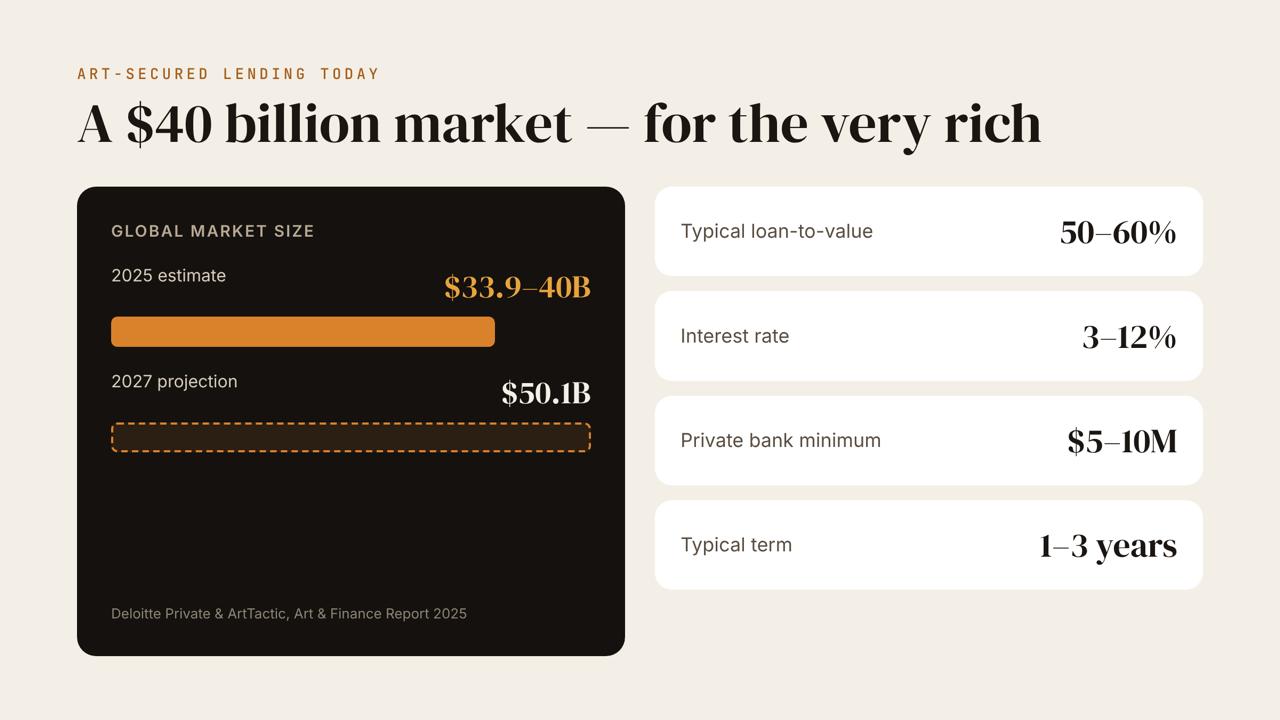
Borrowing against art is not a new idea. It is a real market, and it is growing. The Deloitte Private and ArtTactic Art & Finance Report 2025 estimates the global art-secured lending market at $33.9 to $40 billion in 2025, and projects $50.1 billion by 2027 (Masterworks).
Here is how it works today:
| Feature | Typical terms |
|---|---|
| Who lends | Private banks, specialist art lenders and the finance arms of auction houses |
| Loan-to-value | Usually 50–60%; up to about 70% for blue-chip works; 40% or less for harder-to-sell pieces |
| Interest | Roughly 3–12% a year |
| Minimum size | Private banks often require $5–10 million and an existing relationship; specialist lenders start around $50,000 |
| Term | Usually one to three years |
| Requirements | Independent appraisal, clean provenance, condition review, insurance and often secure storage |
The largest players show how concentrated this market is. Sotheby’s Financial Services alone has a loan book of about $1.6 billion, and private banks such as JPMorgan, UBS, Citi and Bank of America lend mostly to clients who already keep millions with them (Masterworks).
In other words, art already works as collateral — but only at the very top. If you own a Basquiat and bank with a private bank in New York or Geneva, your painting is working capital. If you own a fine Indian modernist work worth a few crore and live in Mumbai, Dubai or Lagos, it almost certainly is not.
The four frictions
Why is a $40 billion market still closed to most owners of art? In my experience it comes down to four frictions, and every one of them is about trust.
- Provenance. A lender has to be sure the work is genuine and that the borrower truly owns it, free of claims. In many markets, including India, ownership histories live in paper files, dealer memories and family archives. Verifying them is slow and expensive, and a single gap can make a work unbankable.
- Valuation. Art has no ticker. Its value is an opinion backed by comparable sales, and those can be months or years apart. Lenders protect themselves by lending only half the value, or less, and by charging for appraisals that make small loans uneconomic.
- Custody. A lender needs to know the painting will still be there, undamaged, if the loan goes bad. That means insurance, condition reports and often moving the work into a secure warehouse. For many collectors, sending a beloved painting into storage defeats the point of owning it.
- Liquidity. If the borrower defaults, the lender has to sell. Art can take months to sell well, and a forced sale often sells badly. That risk is priced into every rate, and it is why lenders favour blue-chip names that sell easily at Sotheby’s or Christie’s.
Put these together and you get today’s market: high minimums, low loan-to-value, slow processes and a heavy tilt towards Western blue-chip art. For Indian art, there is one more layer. The finest works by the nine National Treasure artists cannot leave India, which shuts them out of the international lenders who dominate this business.
None of these frictions is about the art itself. They are about information and enforcement — who can prove what, who holds what, and who can act when something goes wrong.
What has to change
If the frictions are about information and enforcement, then the fix is infrastructure. This is the part of the problem I have spent the last few years on, and I believe four building blocks can open art lending to far more owners.
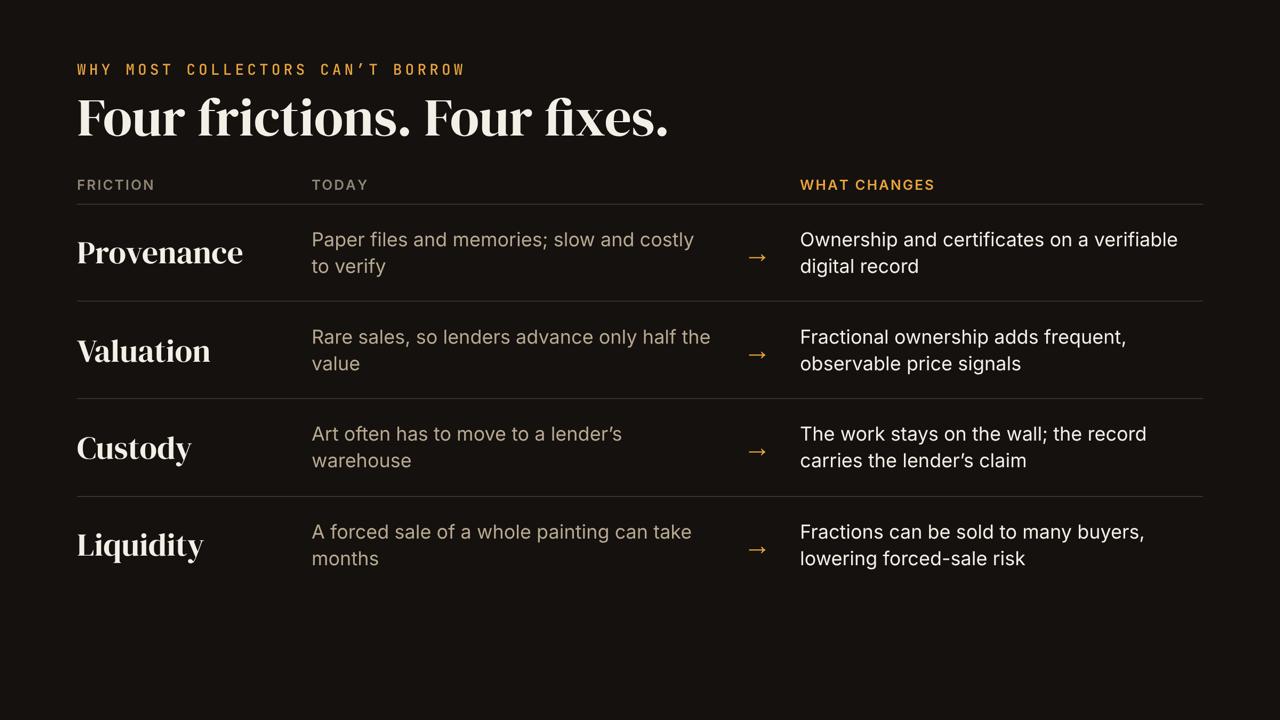
- Provenance on-chain. When an artwork’s ownership history, certificates and condition reports are recorded on a public ledger, a lender can verify them in minutes instead of weeks. This is what we set out to do with the ART-20 standard on Sui: give each artwork a verifiable digital record that travels with it.
- Valuation from more data. Fractional and tokenized ownership creates something art has never had: more frequent, observable price signals. More data points mean tighter valuations, and tighter valuations mean lenders can lend a larger share of a work’s value.
- Custody that does not move the art. A tokenized artwork can stay on its owner’s wall or in a museum loan, insured and documented, while its on-chain record carries the lender’s claim. That matters especially for Indian masterpieces that cannot be exported: the painting stays in India, but its value can still be put to work under clear rules.
- Liquidity through fractions. If a borrower defaults, a lender does not have to sell an entire painting in a hurry. A share of a tokenized work can be sold to many buyers, which lowers forced-sale risk and, in turn, the cost of the loan.
None of this removes the need for experts. Authentication, conservation and judgment still matter, and I would never suggest otherwise. What changes is that their work, once done, becomes a durable, verifiable record rather than a file in a drawer.
I should be clear that this is still early. Regulation of tokenized assets differs from country to country, and the legal link between an on-chain record and a physical painting has to be built carefully. But the direction is clear, and the building blocks now exist.
Why this is a new financial primitive
A financial primitive is a basic building block that other things are built on. A mortgage turned houses into working capital and built the modern housing market. Margin lending turned shares into working capital and built modern trading.
Art has never had its equivalent at scale. When it does — when any well-documented artwork can be verified, valued and used as collateral under transparent rules — a store of value that has been frozen for centuries becomes capital that can move. That is the primitive I believe is coming.
It connects directly to the theme of my earlier essay on the capital formation layer. The real bottleneck in finance is access to capital. Art-backed lending attacks the same problem from the other side: instead of forming capital from scratch, it releases capital that already exists but is locked up in canvas and frame.
What it means for India
India is the market where this matters most. Its art has just set record after record, and the collector base is widening fast among entrepreneurs, professionals and family offices. But most Indian collectors have no practical way to borrow against what they own, and the country’s most important works are legally bound to stay at home.
An Indian collector who can borrow against a documented Raza or Souza without shipping it to a vault in Geneva is a collector who can keep building a collection, fund a business or support an artist. A market where art can work as capital will attract more capital to art. And the masterpieces never have to leave the walls where they belong.
For fifteen years I have worked on making valuable things easier to own. The next step is making them easier to use.
Sources: market size, loan-to-value, rates and lender data from the Deloitte Private and ArtTactic Art & Finance Report 2025, as summarised by Masterworks; earlier market estimates from WealthBriefing.
This essay reflects personal views and is not financial, legal or investment advice. Borrowing against any asset carries risk, including the loss of the asset.