THE CAPITAL FORMATION LAYER / PART 1
November 9, 2026 · Asif Kamal
For most of my career, I have worked on one question: how do you make something valuable easier to own?
I spent years in modern and contemporary art, and then in new-age technology, trying to answer it. With Artfi, our answer was tokenization. We built the ART-20 standard on Sui and brought real artworks on-chain, so that ownership of a masterpiece could be shared rather than reserved for a single wealthy buyer.
But the further I went, the more I noticed a problem that tokenization alone could not solve. Making an asset easier to buy does little for the person who cannot afford to buy it.
That led me to a different question: how do we make capital itself easier to reach? This essay begins a series about the capital formation layer I believe finance is missing, and ObjeX, the protocol I am building to put it on-chain.
The gap beneath the markets
For a trader with limited savings, most financial products begin in the same place. A spot exchange lets you trade what you have. Derivatives let you take greater exposure. Overcollateralised lending lets you borrow against assets you already own. Each depends on a starting base of capital.
The appetite for exposure is enormous. Crypto derivatives traded $85.7 trillion in 2025, according to CoinGlass data reported by Cointelegraph. Decentralised perpetual exchanges traded $6.7 trillion, more than four times the previous year, according to CoinGecko data reported by Yellow. [1, 2]
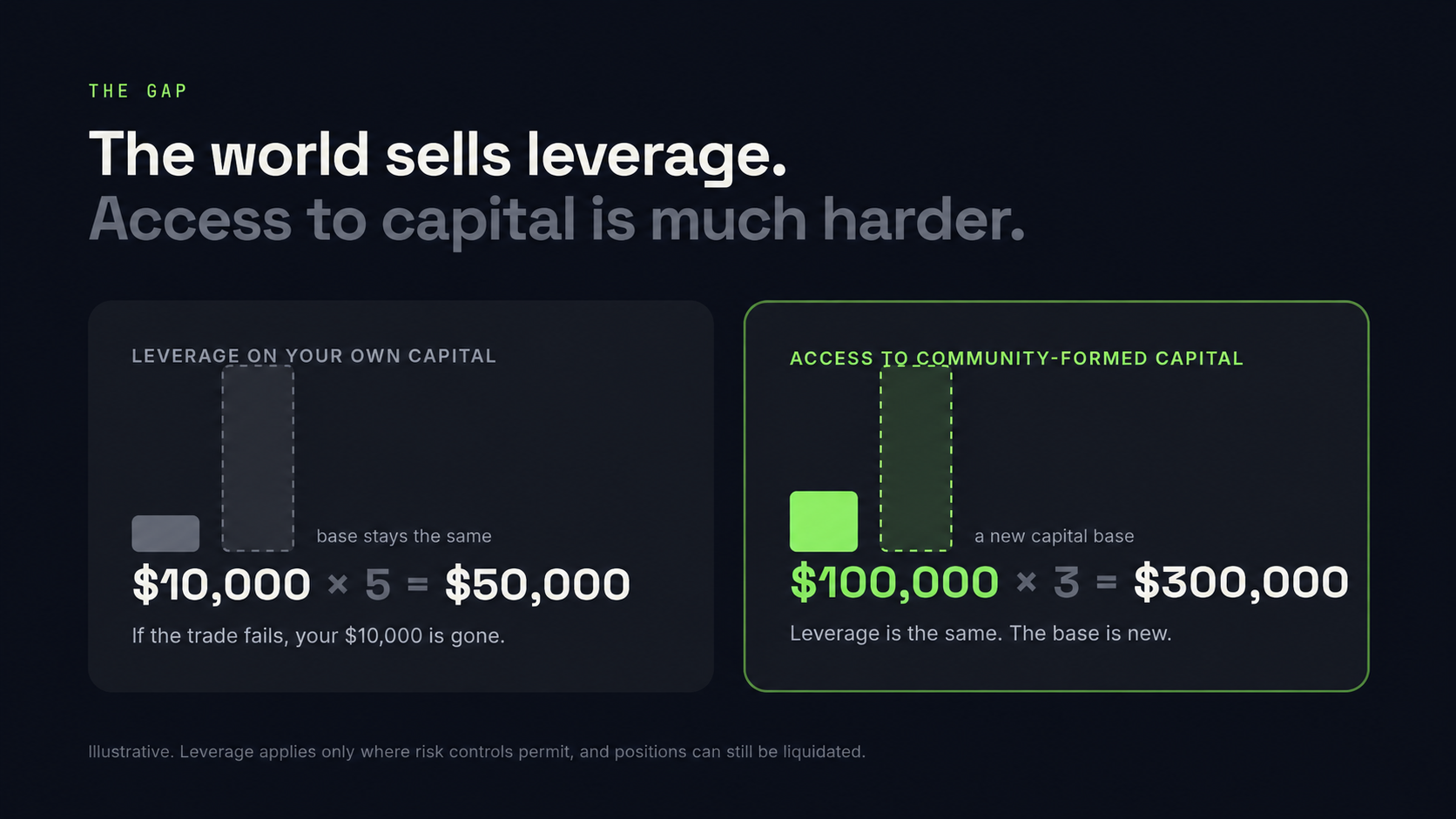
Yet greater exposure does not enlarge your underlying equity. With $10,000 and 5× leverage, you control $50,000 of exposure. Your starting equity remains $10,000, and a sufficiently adverse move can wipe it out.
Prop-trading firms offer another route: pay for an evaluation, trade within the firm’s rules, and share profits if you qualify. Even there, access is difficult. One industry estimate puts the share of challenge buyers who ever receive a payout at about 7%. That is an estimate from one source, not a universal success rate. [3]
The world makes leverage easy to find. Access to capital is much harder.
What savings circles already know
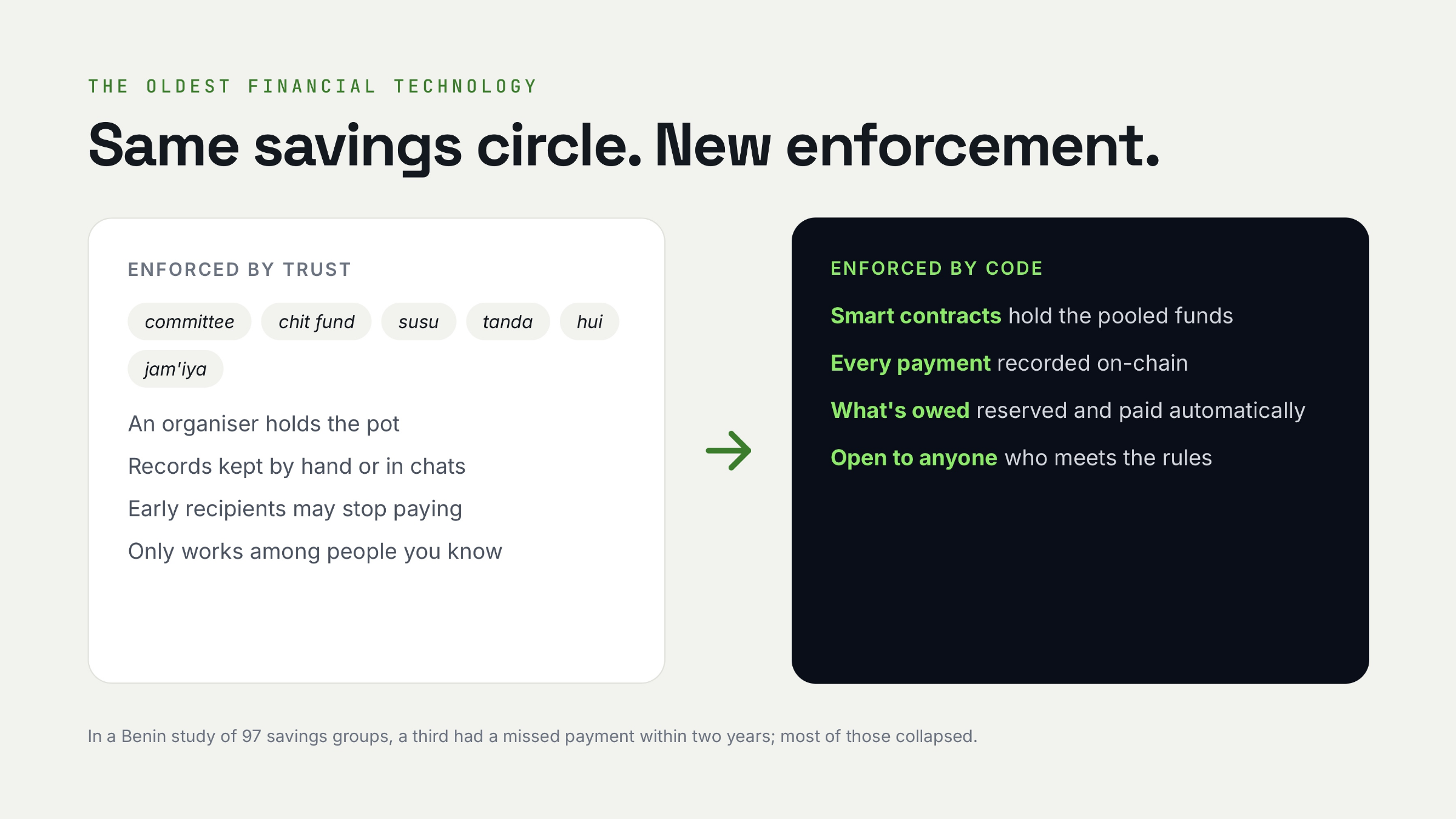
Ordinary people have been working around this problem for centuries. In India, we know the committee or chit fund. Elsewhere, related traditions include the susu, tanda, hui and jam’iya. Economists describe rotating savings and credit associations as ROSCAs, with a history stretching from premodern China to seventeenth-century Korea. [4]
The core idea is simple. Members contribute a fixed amount on a schedule. Each round, one receives the pooled sum. By the end of the cycle, everyone has received it once. An early recipient accesses a lump sum sooner than they could save it alone. A later recipient builds savings through regular contributions. In auction-based versions, members offer a discount to receive the pot earlier.
The International Encyclopedia of the Social Sciences reports historical participation estimates of half to 95% of adults in many African countries, not a current continent-wide measure. [4]
Their strength is also their vulnerability: the relationship among members. After an early payout, the group still needs that recipient to keep contributing. A study of 97 savings groups in Benin found that a third experienced a missed payment within two years, and most of those groups collapsed. [5]
Extending that trust beyond familiar people is the problem I want to work on.
From trust to funded obligations
Blockchain offers a specific tool for this problem: pooled funds can be held and moved by smart contracts according to defined rules, with transactions recorded on-chain. The aim is to make the group’s commitments visible and enforceable without relying on one organiser’s bookkeeping.
The pool has a shared record
Contributions, auction results and allocations can be recorded where members can inspect them. Funds sit in smart contracts rather than in an organiser’s personal custody. Open discount bidding gives members a defined way to compete for earlier access.
The remaining commitment is funded
When a member receives an early allocation, part of it is reserved to cover the contributions they still owe. Those payments are scheduled automatically. Instead of relying only on a promise to keep paying, the design sets funds aside for that obligation.
The aim is to put capital to work while keeping future contributions funded.
This distinction matters. Receiving an allocation does not mean the whole amount is free to spend or lose. The reserve remains tied to the member’s remaining commitments. What can be traded or withdrawn must be assessed against those obligations.
Code does not remove every risk. Contracts must behave as intended, accounting must stay consistent, and market controls must work under stress. Moving enforcement on-chain changes how the system is managed; it does not make the system infallible.
That is the foundation of ObjeX: a way to form capital together, with the obligations attached to it accounted for from the start.
How ObjeX fits together
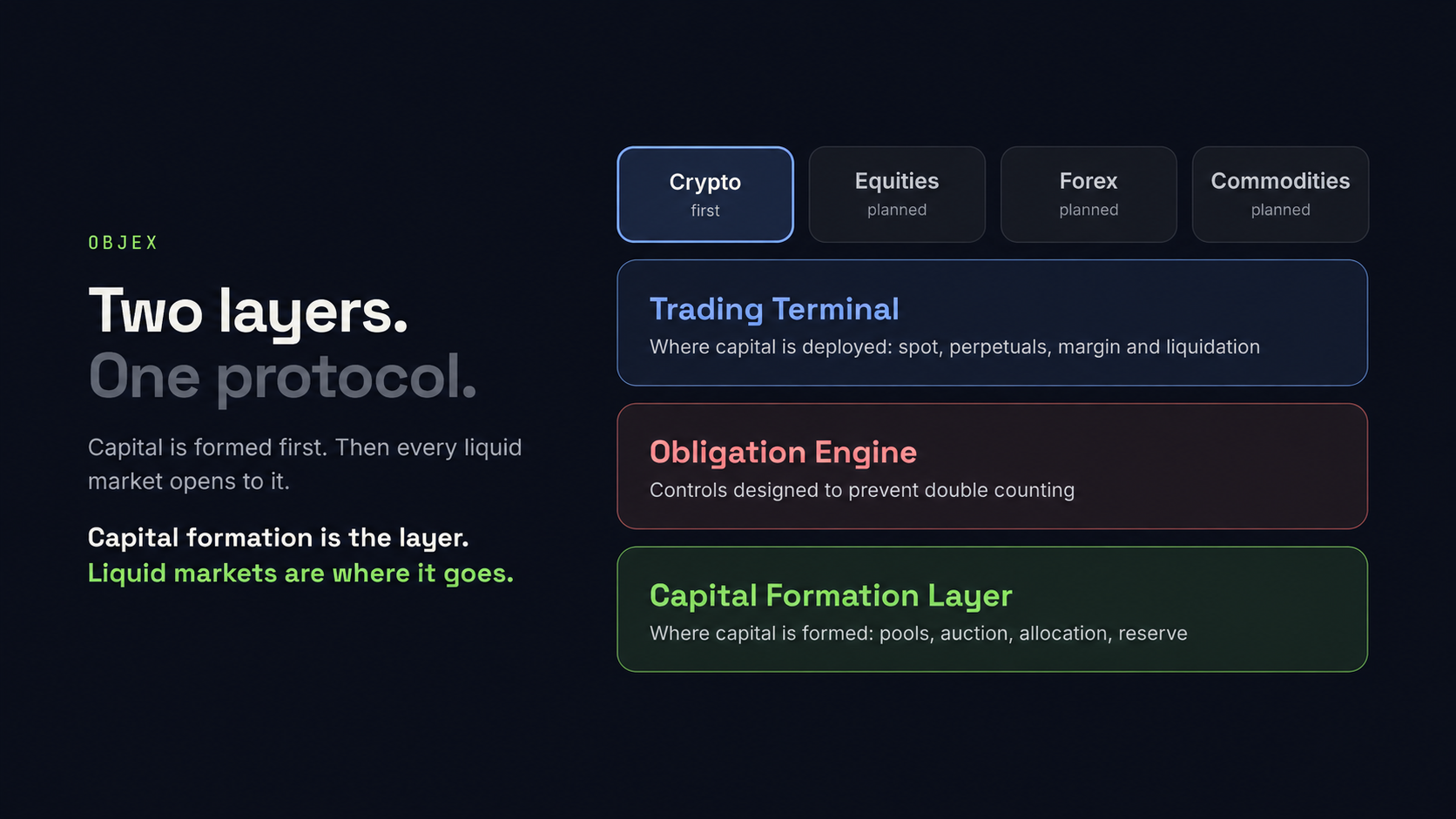
ObjeX has two layers connected by a shared accounting system, the Obligation Engine.
Capital Formation Layer
Members join a pool with a fixed contribution schedule: weekly, monthly or yearly. The pool starts when every seat is filled. Each cycle, members seeking earlier access bid a discount. The winner receives an allocation inside the protocol, with a reserve set aside for their remaining contributions.
Trading Terminal
This is where members can deploy their allocation in liquid markets, subject to the protocol’s risk controls, using spot and perpetual trading. We plan to begin with crypto. Equities, foreign exchange and commodities are planned to follow.
Obligation Engine
Both layers use the same record of contributions, trades, settlements and withdrawals. Its controls are designed to prevent the same dollar from being traded, withdrawn and counted toward an obligation twice.
A worked example makes that relationship clearer.
An allocation in practice
Picture twelve people contributing $10,000 a month. Each month, they form a $120,000 pool. In month three, one member wins the auction by offering a $10,000 discount.
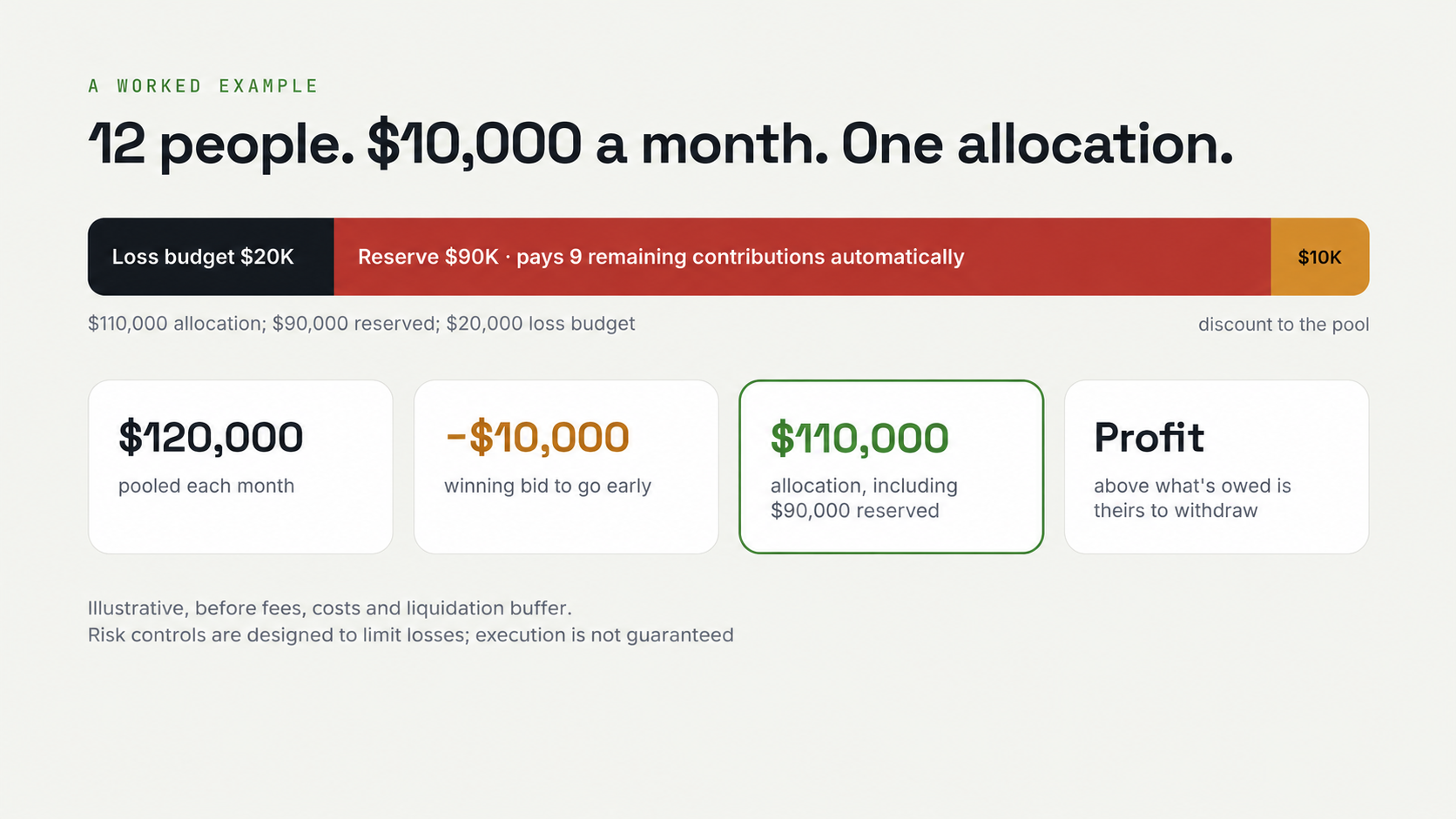
The member’s allocation is $110,000. They still owe nine contributions of $10,000, so $90,000 is reserved for those payments. That leaves a $20,000 loss budget, before fees, costs and any liquidation buffer.
The $110,000 allocation and the $20,000 loss budget describe different things. The allocation includes funds committed to future contributions. The loss budget is the difference between that allocation and those remaining obligations.
Risk controls are intended to close losing positions before losses reach the reserve. Sudden price moves, gaps or execution failures could prevent that. If trading produces gains, withdrawals must still leave enough to cover what the member owes. Later members share in most of the auction discount as compensation for waiting.
What interests me is the source of the allocation: capital that members have pooled together. It brings access forward for one member while preserving commitments to the others. It does not create new money, and it does not make trading risk disappear.
Making capital easier to reach
Tokenization taught me to think about access from the asset side: how more people could own a share of something valuable. ObjeX starts from the other side: how people can bring savings together and make capital available sooner, under a common set of rules.
Savings circles already have a place in families, workplaces and diasporas. If their obligations can be managed reliably on-chain, there may be a way to extend that familiar idea beyond the limits of a small, trusted group. Completed pools could also become a starting point for future ones.
That is why I think of capital formation as a financial primitive. The pool establishes access; the trading layer provides a place to deploy the allocation. Both must be designed around the commitments members still owe.
I have spent my career making valuable things easier to own. ObjeX is the next step: making capital itself easier to reach.
Where we are today. ObjeX is in development, and our contracts are in internal testing. Leveraged positions can still be liquidated. We will publish our parameters and have the code independently reviewed before launch. No system can promise perfect execution through every sudden market move.
Coming in Part 2
Next, I will go inside the Obligation Engine: how the reserve funds scheduled contributions, why the same dollar must never be counted twice, and what happens when a trade goes wrong. After that, I will explore the road from crypto to other liquid markets.
You can follow the project at objex.world.
Sources
[1] CoinGlass via Cointelegraph · Crypto derivatives volume in 2025.
[2] CoinGecko via Yellow · Decentralised perpetuals volume in 2025.
[3] Track360 · Prop-trading industry estimates.
[4] Anderson, International Encyclopedia of the Social Sciences · ROSCA history and participation.
[5] McNabb, LeMay-Boucher and Bonan · Savings-group enforcement study in Benin.
ObjeX is in development and not yet available. This essay is not financial advice or an offer of any kind. Trading, especially with leverage, carries a high risk of loss.