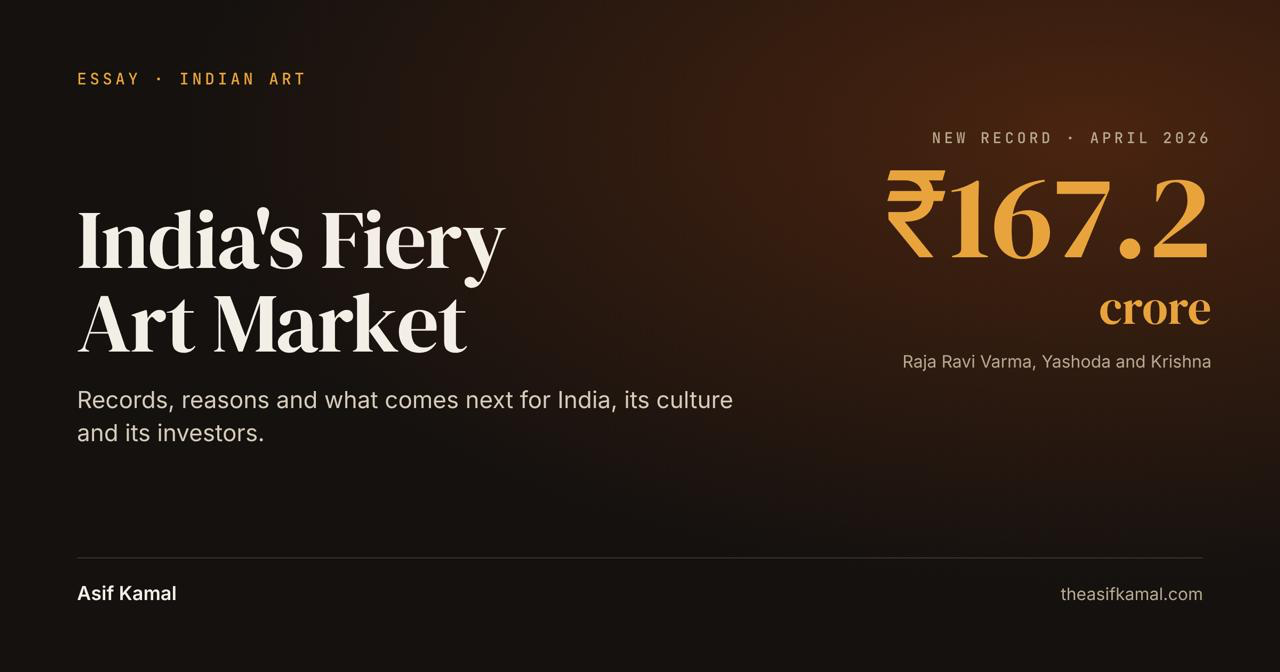
When I opened Alturaash Art in 2011 to promote Indian art, a crore-rupee painting was headline news. In April 2026, a single work by Raja Ravi Varma sold for ₹167.2 crore.
That one number tells the story of the last few years. Indian art has stopped being a niche corner of the global market. Records that stood for a decade have fallen one after another, and each new record has lasted a shorter time than the one before.
I have watched this market from the inside for fifteen years, first as a gallerist, then from Dubai, and now through tokenization. In this essay I want to look at what has happened, why it is happening now, and what it means for India, its culture and the people who want to invest in it.
Three years, three records
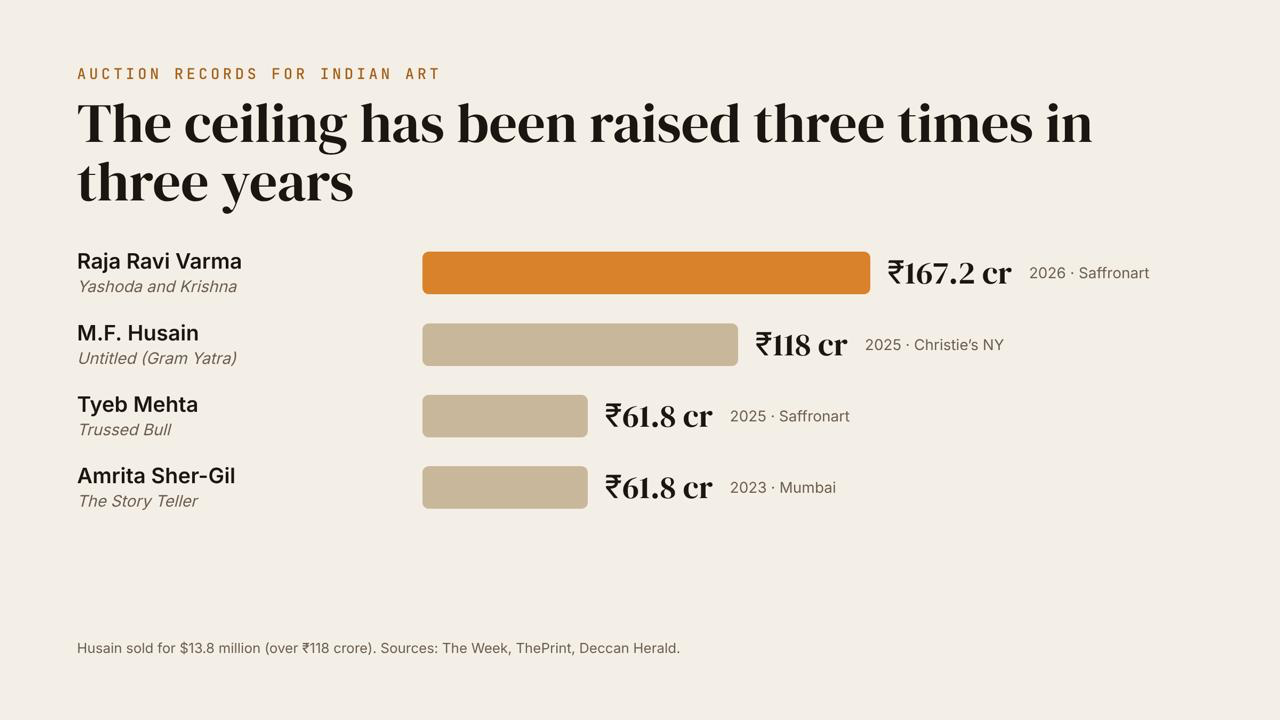
The ceiling for Indian art has been raised three times in three years, and each time by a wide margin.
| Year | Artist | Work | Price | Where |
|---|---|---|---|---|
| 2026 | Raja Ravi Varma | Yashoda and Krishna (1890s) | ₹167.2 crore | Saffronart, Mumbai |
| 2025 | M.F. Husain | Untitled (Gram Yatra) (1954) | $13.8 million (over ₹118 crore) | Christie’s, New York |
| 2025 | Tyeb Mehta | Trussed Bull | ₹61.8 crore | Saffronart |
| 2023 | Amrita Sher-Gil | The Story Teller (1937) | about $7.4 million (₹61.8 crore) | Mumbai |
The Husain record
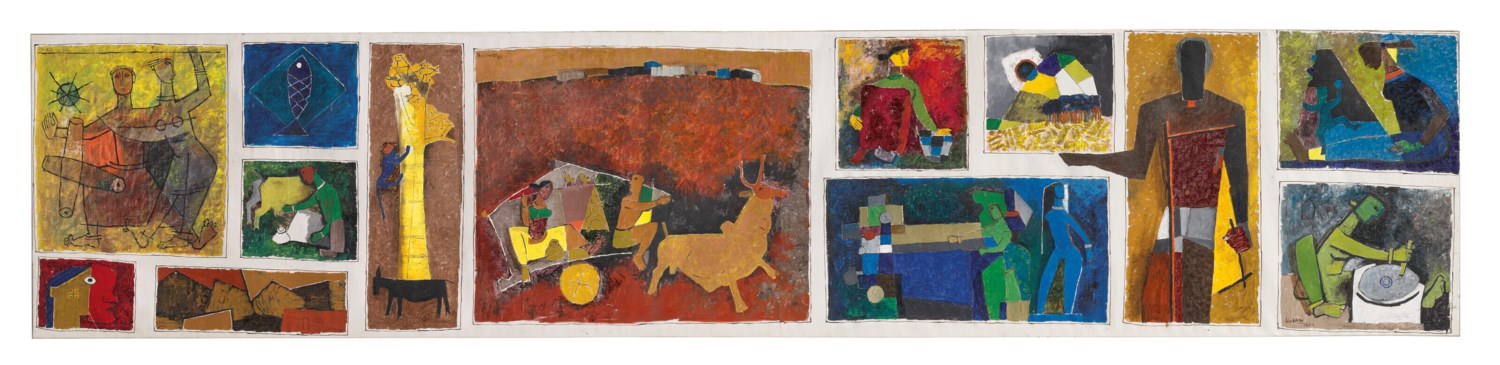
Untitled (Gram Yatra)
M.F. Husain · 1954
US$13.75m
About ₹118 crore · Including buyer’s premium
Christie’s, New York · 19 March 2025
View auction record
M.F. Husain led the way. In March 2025, Untitled (Gram Yatra), a 13-panel work almost 14 feet long, sold at Christie’s New York for $13.8 million, nearly double the previous record for Indian art (ThePrint). The painting had left India in 1954 and spent decades largely unseen at Oslo University Hospital, which received it as a bequest in 1964. Husain’s own previous best had been $3.1 million. In a single evening, his market moved into a different league.
The Tyeb Mehta record
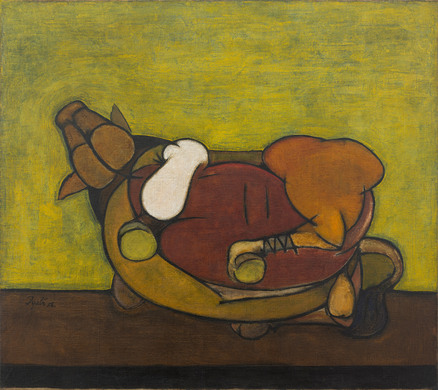
Trussed Bull
Tyeb Mehta
1956 · Oil on canvas
₹61.8 crore
Saffronart, Mumbai · 2 April 2025
Including buyer’s premium · View auction record
Tyeb Mehta followed weeks later. Trussed Bull sold at Saffronart for ₹61.8 crore, the artist’s record, matching Amrita Sher-Gil’s The Story Teller as the second-highest price for an Indian artist at the time (Deccan Herald). Mehta’s falling figures and trussed bulls are some of the most powerful images in Indian modernism, and the market has finally priced them that way.


A new auction record
Yashoda and Krishna
Raja Ravi Varma
Circa 1890s · Oil on canvas
₹167.2 crore
Saffronart, Mumbai · 1 April 2026
Including buyer’s premium · View auction record
Raja Ravi Varma then reset the whole market. In April 2026, Yashoda and Krishna, painted in the 1890s, sold at Saffronart’s Spring Auction in Mumbai for ₹167.2 crore to Cyrus Poonawalla, founder of the Serum Institute of India (The Week). It is a registered antiquity and cannot leave India, which makes the price even more remarkable: this record was set by Indian buyers, in India, for a work that must stay at home.
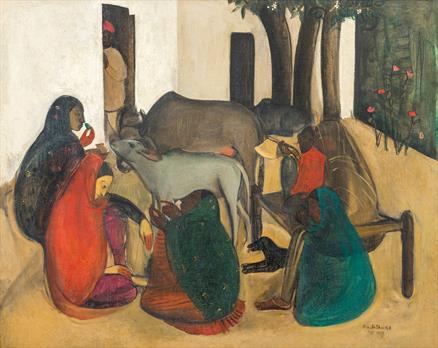
The Amrita Sher-Gil record
The Story Teller
Amrita Sher-Gil
1937 · Oil on canvas
₹61.8 crore
Saffronart · 16 September 2023
Including buyer’s premium · View auction record
The records are not limited to famous names. In a recent sale, Asit Kumar Haldar’s Mother India sold for ₹2.07 crore against an estimate of ₹8–12 lakh, more than 25 times its lower estimate (Daily Excelsior). When lesser-known artists start beating their estimates by twenty times or more, a market is not just rewarding a few icons. It is being rediscovered.
Why now
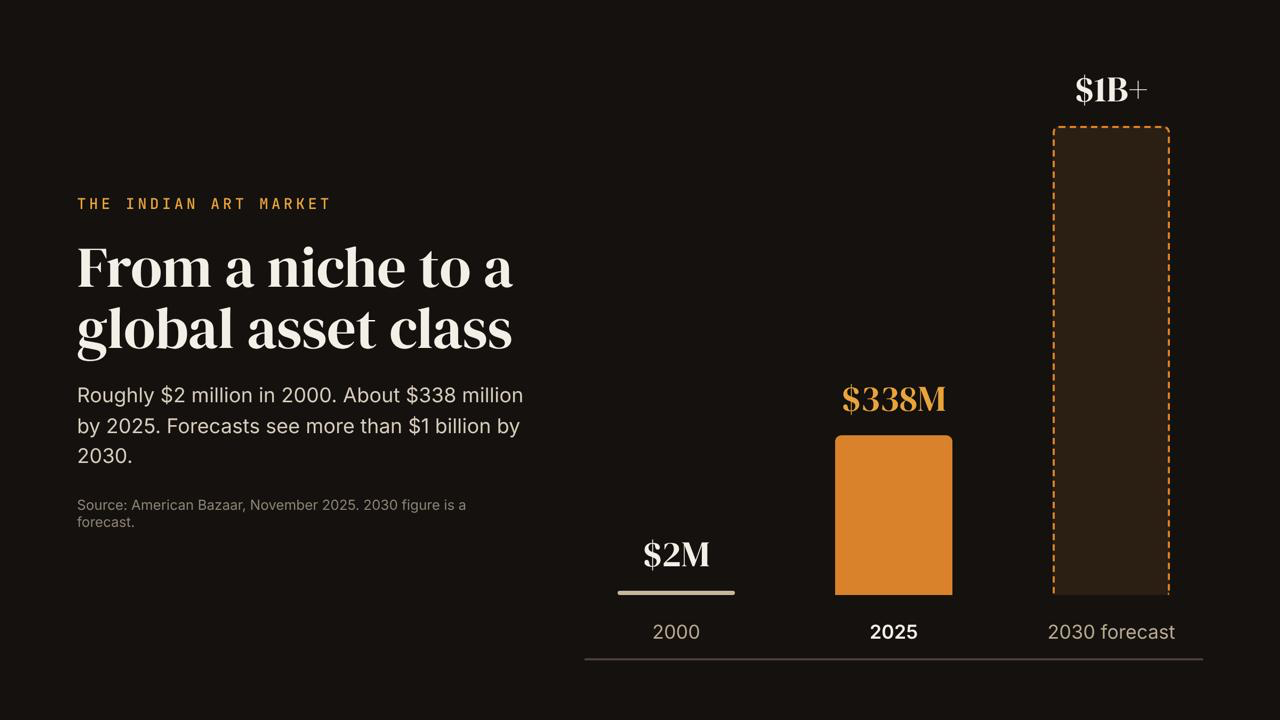
The Indian art market has grown from roughly $2 million in 2000 to about $338 million by 2025, and some forecasts see it passing $1 billion by 2030 (American Bazaar). Four forces are behind it.
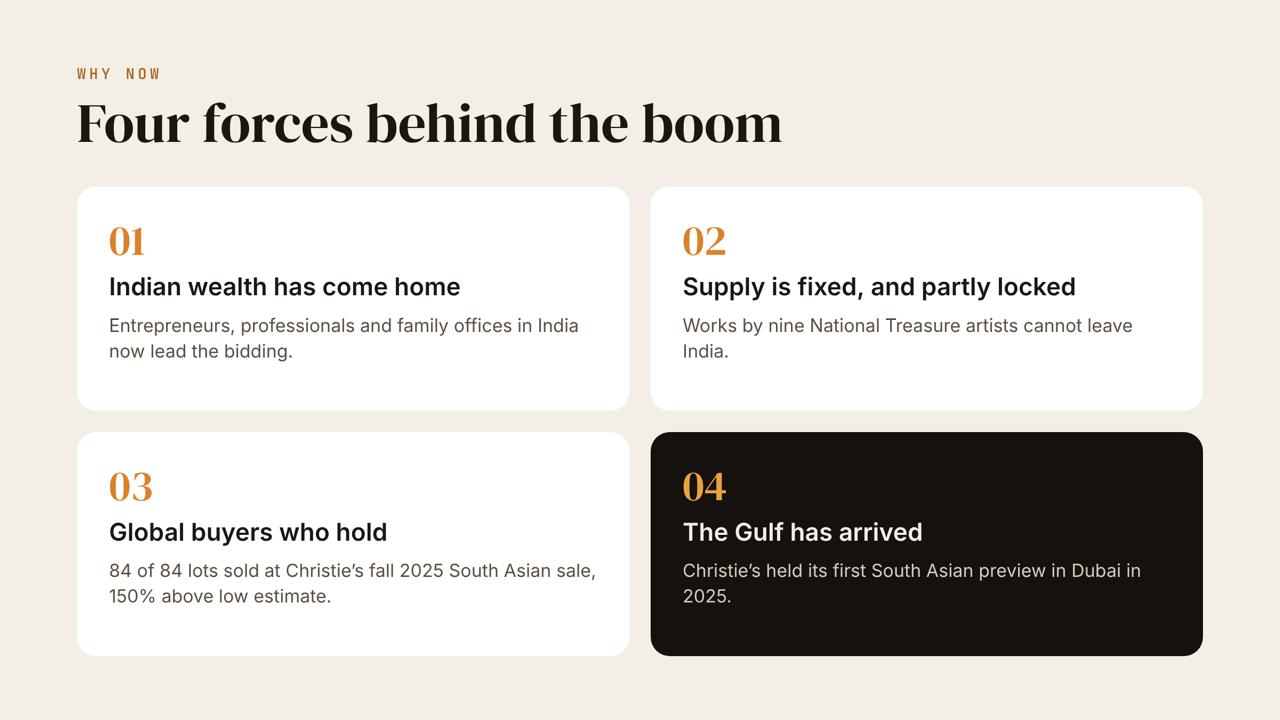
1. Indian wealth has come home to Indian art. For years, the biggest buyers of Indian art lived abroad. Today the deepest pockets are in India itself — entrepreneurs, professionals and family offices. The collector base “is becoming broader,” as AstaGuru’s Manoj Mansukhani puts it (Daily Excelsior). The Ravi Varma record, set in Mumbai by an Indian buyer, is the clearest sign of that shift.
2. The supply of masterpieces is fixed, and partly locked. Since 1972, India has designated nine artists as “National Treasures” whose works cannot be exported, including Raja Ravi Varma and Amrita Sher-Gil. That keeps the best works in India and pushes up demand for the few already abroad (American Bazaar). Masterpieces with clean provenance rarely come to market at all. When one does, every serious collector in the world is bidding.
3. The buyers are global and they are holding. At Christie’s fall 2025 South Asian sale in New York, every one of 84 lots sold, for $12.38 million, 150% above the low estimate, with buyers from India, the United States, the United Kingdom, the UAE and Singapore. “Most collectors are buying to hold,” said Christie’s Nishad Avari. That matters: a market of long-term holders is far steadier than one driven by quick flips.
4. The Gulf has entered the picture. Christie’s held its first South Asian preview in Dubai in 2025. As someone who has worked in this city since 2014, I am not surprised. Dubai sits between India’s collectors and the world’s capital, and it is becoming a natural hub for this market.
What lies ahead
For India, this is about more than price. Every record is also a statement about value in the cultural sense. For decades, Indian modernism was priced as a regional curiosity next to Western art of the same period. A Husain at $13.8 million, or a Ravi Varma that must stay in India and still sets a national record, says something different: this is world-class art, and India now has the wealth and the confidence to own its own heritage.
For culture, the opportunity is to build institutions as fast as prices. High prices bring scholarship, restoration, museums and public attention. They also bring forgeries and speculation. The market’s long-term health depends on what grows alongside it: rigorous provenance, catalogues raisonnés, conservation and public collections that let ordinary Indians see these works, not just read about their prices.
For investors, the gap is still wide. Even the record Husain is a fraction of what Western masters of the same generation command. The top end is thin, supply is tight, and the collector base is widening at home and across the Gulf, Asia and the diaspora. If the forecasts are right and the market triples by 2030, much of that growth will come from artists who are still well below their potential, the way Tyeb Mehta and Husain were a decade ago.
The next frontier is access. Today, owning a museum-grade Indian painting takes crores. Most people who love this art and believe in its future can never take part. That is the problem I have worked on through tokenization, and it is where I believe the next chapter of this market will be written: more owners, more transparency and more capital flowing into Indian art — without the masterpieces ever leaving the walls where they belong.
A word to new collectors
Records make headlines, but they are not a strategy. Three lessons from fifteen years in this market:
- Buy provenance, not just a name. A documented history is what turns a painting into a lasting asset. A gap in that history can erase its value.
- Look beyond the icons. The surprises of recent years came from artists bought before the world caught up.
- Buy to hold. The strongest collections are built over decades. The market rewards patience far more than timing.
India’s art market is on fire. The question now is whether we use this moment to build something that lasts.
Sources: The Week on the Raja Ravi Varma sale; ThePrint on the M.F. Husain sale; Deccan Herald on the Tyeb Mehta sale; American Bazaar on market size and Christie’s fall 2025 sale; Daily Excelsior on the widening collector base.
This essay reflects personal views and is not investment advice. Art prices can fall as well as rise, and past auction results do not predict future value.