Every art price you have ever read is in dollars. Change the unit, and the story of the art market changes with it, which tells you less about art than you might think.
By Asif Kamal
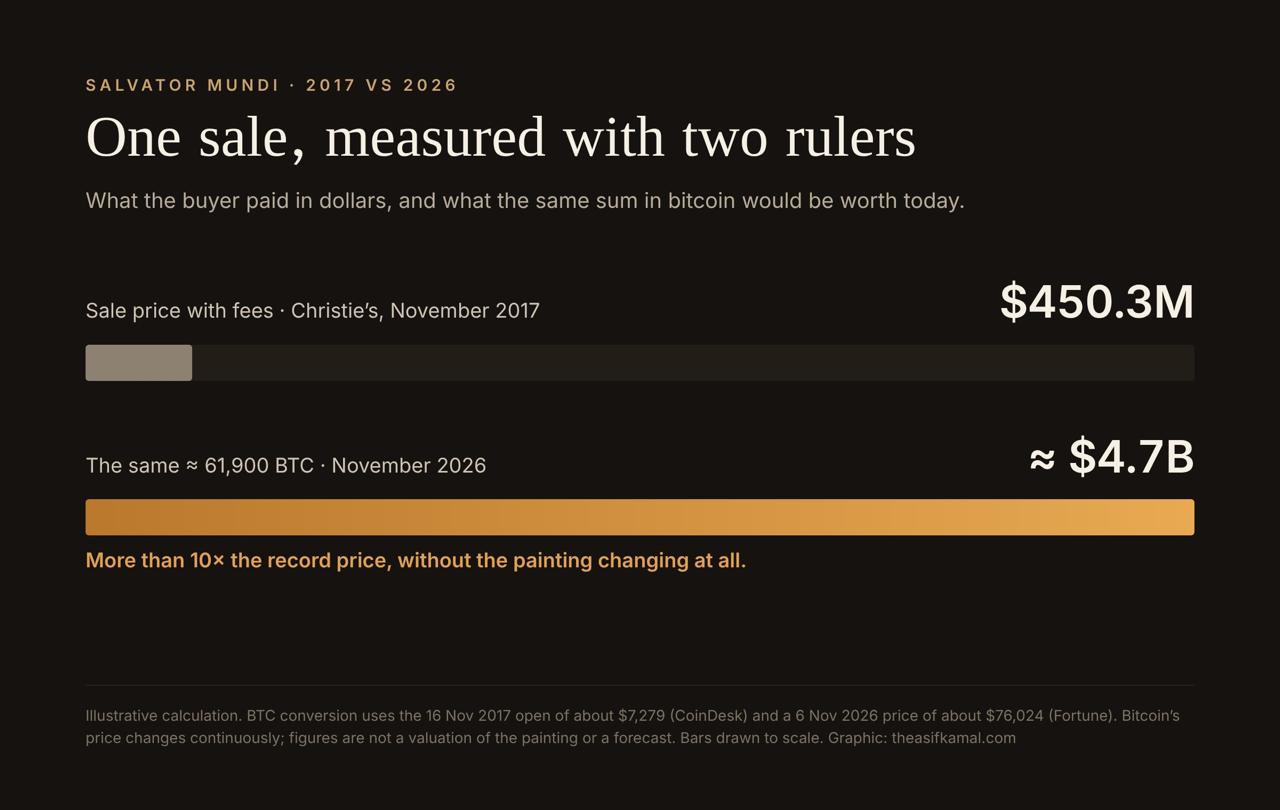
In November 2017, Leonardo da Vinci’s Salvator Mundi sold at Christie’s in New York for $450.3 million, the most ever paid for a painting at auction. (Artnet News)
The next morning, bitcoin opened at about $7,279. (CoinDesk)
Do the division and the record painting cost roughly 62,000 bitcoin. On 6 November 2026, bitcoin traded at about $76,000. (Fortune) Those same 62,000 coins would now be worth around $4.7 billion, more than ten times what the buyer paid.
So was Salvator Mundi the most expensive painting ever sold, or one of the great bargains in history? The answer depends entirely on which ruler you hold up to it. That is the question I want to think through here.
The unit you measure in is not neutral
We rarely notice the unit of account, because in the art world it has always been the dollar, with the pound and the euro in supporting roles. Auction records, appraisals, insurance values and market reports are all written in it.
The 2026 Art Basel and UBS report, for instance, estimates that global art sales rose 4 percent to $59.6 billion in 2025, after two years of decline. (Art Basel and UBS, 2026) That is a modest recovery story, and it is told in dollars.
Now look at the same period through bitcoin. A year before that 6 November price, bitcoin was trading near $101,000, so it fell by roughly a quarter in dollar terms. (Fortune) Measured in bitcoin, any painting that simply held its dollar value over those twelve months became about a third more expensive.
Same paintings. Same buyers. Same walls. A completely different headline.
Most of what you see is the ruler moving
Here is the part that is easy to miss. Art prices move slowly. A blue-chip work might be reassessed once every few years, when it comes to market. Bitcoin’s price moves every second, and it has moved violently.
When you divide something slow by something fast, the result mostly reflects the fast thing. A chart of “art priced in bitcoin” is, for long stretches, just a chart of bitcoin turned upside down.
That has a sobering implication. When someone says blue-chip art looks “cheap in bitcoin terms,” they are usually saying bitcoin looks expensive in dollar terms. That might be a reasonable view. But it is a view about bitcoin, not about the painting.
To learn anything about art from a bitcoin-denominated price, you have to separate the two movements. You need to know what the work would fetch in a currency that held still, and only then layer the exchange rate on top. Otherwise you are reading the ruler, not the object.
The art world adopted the rail, not the ruler
In May 2021, Sotheby’s sold Banksy’s Love Is in the Air for $12.9 million. It was the first time the house accepted cryptocurrency for a physical artwork, with bitcoin and ether both on offer through Coinbase. (The National)
That sale is usually told as the moment crypto entered the auction room. I read it differently. Look at how the price was set and reported: in dollars. Crypto was a way to settle the bill, not the language the market thought in.
This distinction matters more than it looks. A payment rail changes who can buy and how quickly money moves. A unit of account changes how everyone in the market keeps score: what counts as a gain, what counts as a loss, and when it feels right to sell.
The art market has opened the door to the first. It has barely considered the second.
What changes when a collector keeps score in bitcoin
From my years with collectors, I can tell you that the currency they think in quietly shapes almost every decision they make. Bitcoin-native collectors will be no different, and their scorecard will produce some strange incentives.
Consider a hypothetical. A collector buys a painting for 100 bitcoin. Three years later, the dollar value of the work has risen 20 percent, a good result by most art-market standards. But bitcoin has doubled in that time. In her own unit, she is down 40 percent. If she ever sells, she will want to sell for bitcoin, and she will feel that loss.
Now reverse it. Bitcoin halves, and the painting holds its dollar value. In her terms, the painting has doubled. She may well sell, not because anything about the art changed, but because her ruler shrank.
Multiply that behaviour across a growing group of collectors and you get something new: art demand that rises and falls with the bitcoin cycle. Works could come to market when bitcoin falls, as holders rotate into a stable store of value, and dry up when it rises. That is a hypothesis, not a finding. But it is the kind of pattern I would expect to see, and it is worth watching for.
The honest answer: use both rulers
None of this means bitcoin is the “true” measure of art and the dollar is an illusion, or the reverse. Every unit of account is a choice, and each one hides something.
The dollar hides inflation and the slow erosion of purchasing power. Bitcoin hides its own volatility, presenting a moving ruler as if it were the fixed point everything else orbits around.
The discipline a serious collector needs is to hold both and to know which question each one answers. Dollars tell you what a work commands in the market where it actually trades. Bitcoin tells you what you gave up by owning the work instead of holding the coin. Both are useful. Neither, on its own, tells you whether you made a good decision.
The question worth asking
I have spent more than fifteen years pricing art, and the last several building technology for owning it. What strikes me most about this exercise is how much of the “performance” of any asset lives in the unit you choose to measure it in.
For a collector who lives in both worlds, the useful question is not “Is art cheap in bitcoin?” It is this: in which currency will I eventually need this wealth, and which asset is more likely to get it there?
A painting cannot answer that. Neither can a protocol. That decision is still, stubbornly, yours.